
- Duration2 days (qualification) or 3 days (with practical exam)
- Exams includedWritten and practical signalperson exams
- Best forRiggers, laborers, foremen and anyone directing crane movement
- StandardASME B30 hand and voice signals; OSHA 1926.1428
When a Lift Depends on Someone Else's Eyes
A signal person is needed whenever the operator cannot see the whole picture: when the point of operation, meaning the load's travel path or the landing area, is out of the operator's view, when the view in the direction of travel is blocked, or when the operator or the person handling the load decides site conditions call for one. In those moments the crane is effectively being driven by the person on the ground.
OSHA requires anyone giving signals on a construction crane to be qualified under 29 CFR 1926.1428, either by a third-party qualified evaluator or by an employer's qualified evaluator. This program prepares you for signalperson certification through NCCCO and also supports employer qualification, so your signals hold up both on paper and on the job.
Communication Rules You Will Live By
Good signaling is mostly discipline. The class drills the rules that keep operator and signalperson in step:
- Communication between operator and signalperson must be maintained continuously during all crane movements. If it breaks down, the operator stops until it is restored.
- If the operator has a concern about a requested movement, all crane movement stops until the two agree the issue is resolved.
- Any instruction outside the established signal system requires the crane to be stopped first.
- Signals must be discernible or audible at all times, and the operator does not respond to a signal that is not clearly understood.
These sound obvious until a radio cuts out mid-swing or two people start signaling at once. Practicing the stop decision is a big part of the training.
Hand, Voice and Special Signals
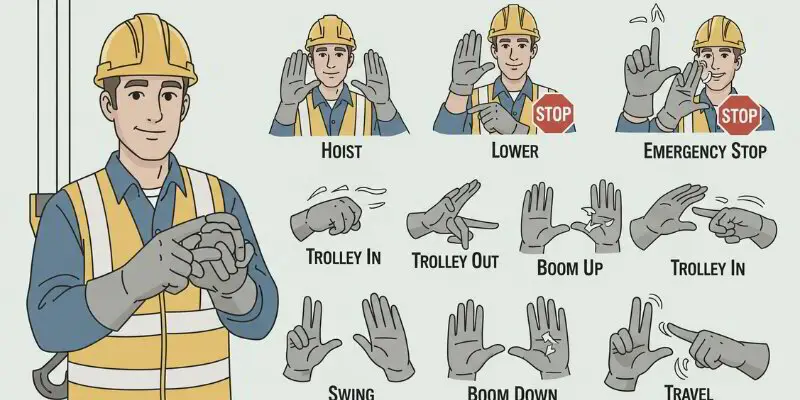
Standard hand signals
You will learn the ASME B30 standard hand signals for mobile cranes, the chart that is supposed to be posted at the job site, until each one is crisp and unambiguous.
Voice signals
Voice signaling by radio follows a set procedure: test the devices before use, establish contact between operator and signalperson, and give directions from the operator's perspective. Each voice signal carries three elements: the function and direction, the distance or speed, and the function stop.
Special signals and travel signals
For attachments or operations the standard signals do not cover, special signals must be agreed on in advance by the person directing the lift, the operator and the signalperson, and they cannot conflict with standard signals. When the crane travels, audible signals apply: one short signal to stop, two to go ahead and three to back up.
Who Should Take This Class
Signaling is rarely anyone's only job title. The people who benefit most are riggers and ironworkers who hook loads and then guide them in, laborers and foremen who direct deliveries, lift supervisors who need to step in when the regular signalperson is off, and crane operators who want to understand the signals from the other side. It is not suitable as a substitute for operator training; you will learn how cranes respond, not how to run one.
No prior certification is needed to enroll, but candidates must be at least 18 to sit for the NCCCO exams.
Crane Dynamics for People Who Don't Sit in the Cab
Signalpersons need a working sense of how a crane behaves: how a load swings when a slew starts or stops, why booming down increases radius and reduces capacity, how long it takes a hoist to respond, and what power lines and other obstructions mean for the path you choose. The first part of the class covers mobile crane dynamics and awareness so your signals account for what the machine can and cannot do safely.
Inside the NCCCO Practical Exam
The CCO signalperson practical exam typically takes about 15 minutes, though there is no overall time limit. Candidates watch a preparatory video first, then work through 16 scenarios of two kinds:
- Match scenarios, where you give the signal that matches a crane function you are shown
- Candidate-initiated scenarios, where you direct crane movements yourself within a time limit
Examiners look for signals that are clear, precise and given one at a time, held consistently until the function is complete, and stopped when needed. Any unsafe signal is a problem, and in multi-signal scenarios every signal must be correct. You will need photo ID, and following the examiner's instructions exactly matters. Our instructors include accredited signalperson practical examiners, so practice runs mirror the real format. For extra study, see these signalperson exam tips.
Class Format and Published Prices
Open-enrollment signalperson classes run several times a year at our Seffner facility and are listed on this page and the schedule calendar. They are usually set for the same dates as our rigger classes, which suits crew members who need both.
- Signal Person Qualification, 2 days: $425. Classroom training and testing toward qualification without the NCCCO practical.
- Signal Person Only Certification (with Practical), 3 days: $1,375. Two days of instruction, then the practical exam on day three.
- Signal Person Practical Only: for experienced signalpersons who only need the practical on day three. Call for pricing.
Preparing for Class and Signing Up
Bring your hard hat, hard-toe footwear, gloves and work clothes, plus government-issued photo ID and a valid driver's license. Training materials are provided.
Register using the form on this page and select the Signalperson Qualification / Certification Program, or call (813) 402-2017 between 7:00 AM and 4:00 PM, Monday through Friday. Companies can also have this class taught and tested at their own site, where crews can practice signaling the cranes they actually work around.