Comparing Crane Inspection Services in Florida: Which Option Fits Your Fleet?
Crane Inspection Services in Florida: Your Three Main Options
Florida's private employers fall under federal OSHA, so the inspection rules are the same ones contractors follow in most of the country: 29 CFR 1926.1412 for construction cranes, and 1910.179 or 1910.180 for cranes used in general industry. The rule does not say who you must hire. It says the inspections must be done by a competent person or a qualified person, depending on the type.
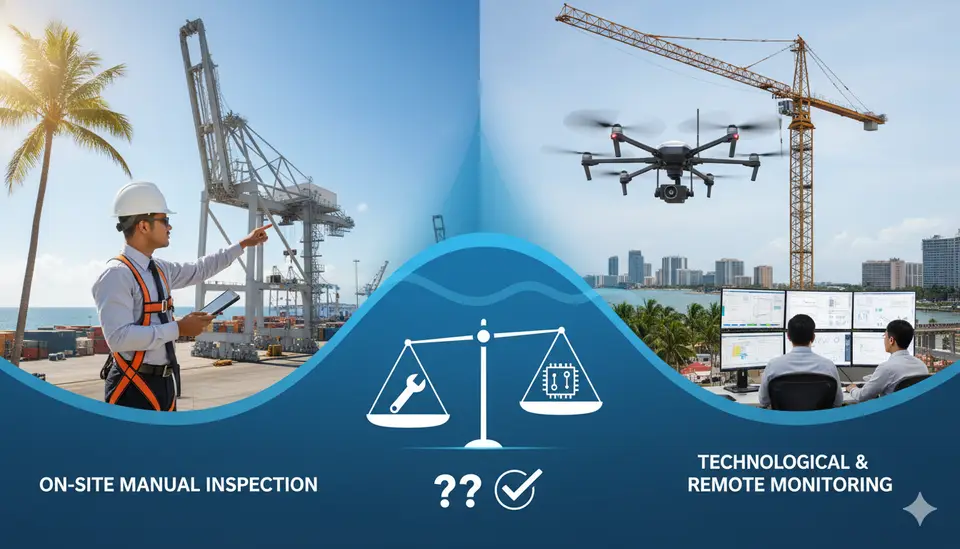
That leaves room to choose. When you compare crane inspection services in Florida, you are usually weighing three options: your own staff, the dealer or manufacturer's service department, or an independent third-party inspector. Many fleets end up with a mix.
Option 1: In-House Inspections
Shift and monthly inspections are commonly handled by your own people, and that makes sense. Your operators and mechanics see the machine every day.
Works well when:
- You have trained competent persons on every shift
- Your mechanics know the specific makes and models you run
- You keep consistent forms and records
Watch out for:
- Annual/comprehensive inspections need a qualified person, and not every in-house team has one
- People inspecting their own repairs can miss things
- Records tend to lapse when the busy season hits
Option 2: Dealer or Manufacturer Service
Dealers bring deep knowledge of their brand, access to service bulletins and factory parts. If your fleet is mostly one manufacturer, that can be a real advantage for repairs and post-repair inspections.
Works well when:
- The machine is under warranty or covered by a service agreement
- The work involves brand-specific systems, software or load moment indicator calibration
Watch out for:
- Mixed fleets may need several dealers
- Scheduling can depend on the dealer's own workload
- The inspector may also be the one quoting the repairs, so ask how findings and repair estimates are separated
Option 3: Independent Third-Party Inspectors
An independent inspector has no stake in selling parts or repairs. That separation is why many general contractors, owners and insurers prefer third-party annual inspections.
Works well when:
- You need an annual/comprehensive or post-assembly inspection by a qualified person
- A project owner or insurer asks for independent documentation
- You run several brands or types (mobile, tower, overhead, articulating)
- You want load testing or a post-incident inspection
Watch out for:
- Credentials vary widely. Ask what certification the inspector holds and for which crane types.
Quick Comparison
| Factor | In-house | Dealer | Independent |
|---|---|---|---|
| Shift and monthly checks | Strong fit | Rare | Possible |
| Annual/comprehensive | Only with a qualified person | Common | Common |
| Mixed-brand fleets | Depends on staff | Limited | Strong fit |
| Separation from repair sales | Not applicable | Weaker | Stronger |
| Documentation for owners and insurers | Varies | Good | Good |
No option is right for every fleet. A small contractor with two boom trucks might do daily and monthly checks in-house and bring in an independent inspector once a year. A company with a large mixed fleet might use all three.
Questions to Ask Any Inspection Provider
Before you book anyone, get clear answers to these:
- What certifications do your inspectors hold? NCCCO offers crane inspector certification by equipment category. Ask for the card and check the type matches your crane.
- Which crane types do you inspect? Mobile, tower, overhead, articulating and personnel hoists each have different requirements.
- Which standards do you inspect to? Expect OSHA plus the relevant ASME B30 volume and the manufacturer's manual.
- What does the report include? You want item-by-item findings, photos of deficiencies and a clear statement of what must be fixed before use.
- Do you offer load testing? Useful after major repairs or modifications.
- Can you come to our site? In Florida, cranes are often spread across job sites from the Panhandle to Miami.
Be cautious of anyone who promises to pass a crane before seeing it.
Match the Provider to the Inspection Type
Different inspections call for different people. Use this as a rough guide when assigning work:
- Shift inspection: competent person, usually the operator or a designated crew member
- Monthly inspection: competent person, documented and kept on file
- Annual/comprehensive inspection: qualified person, often an independent or dealer inspector
- Post-assembly inspection: qualified person, before a newly erected crane goes to work
- After repairs or modifications: qualified person, to confirm the work was done correctly
- Post-incident inspection: qualified person, ideally someone who was not involved in the event
- Load testing: a provider with test weights or calibrated load cells and documented procedures
If your team covers the first two well, you may only need outside help for the deeper inspections. If your crew turns over often or works across multiple sites, outside support for monthly inspections can also help keep records consistent from one job to the next.
Whatever mix you choose, put it in writing. A one-page inspection plan that names who does what for each machine makes audits, owner reviews and insurance questions much easier to answer.
Florida Conditions to Mention to Your Inspector
Salt air along the coasts speeds up corrosion on wire rope, pins and structural members. Summer storms and hurricane season mean cranes may be lowered, secured and re-erected more often, and each re-erection can call for a post-assembly inspection. Heat and humidity also affect hydraulic systems and electrical components. Share how and where the crane works so the inspector knows what to look for.
For more on the legal framework, read our guide to Florida crane inspection regulations. If you are searching outside Florida, our post on finding crane inspection services near you covers what to expect on inspection day.
How The Crane School Can Help
The Crane School is based in Seffner, east of Tampa. Our crane inspection services cover mobile, tower, buck hoist, overhead and articulating cranes, including annual, post-assembly, monthly, post-incident and specialized inspections, plus load testing. Our inspectors are NCCCO certified crane inspectors.
To talk through which inspection mix fits your fleet, contact our team.
FAQ
Does Florida have its own crane inspection law?
Florida does not run an OSHA state plan for private employers, so federal OSHA crane rules apply. Some local jurisdictions add permitting or storm-preparation requirements, so check with the local building department for your project.
Can our own mechanic perform the annual crane inspection?
Yes, if that person meets OSHA's definition of a qualified person for that equipment. Many companies still use an independent inspector for the annual to get a separate set of eyes.
How do I verify an inspector's NCCCO certification?
Ask to see the inspector's card and confirm the certification covers your crane type. NCCCO also provides a way to verify certification status on its website.