Dual Crane Operation Training: Planning and Running Tandem Lifts Safely
What a Dual Crane Lift Is
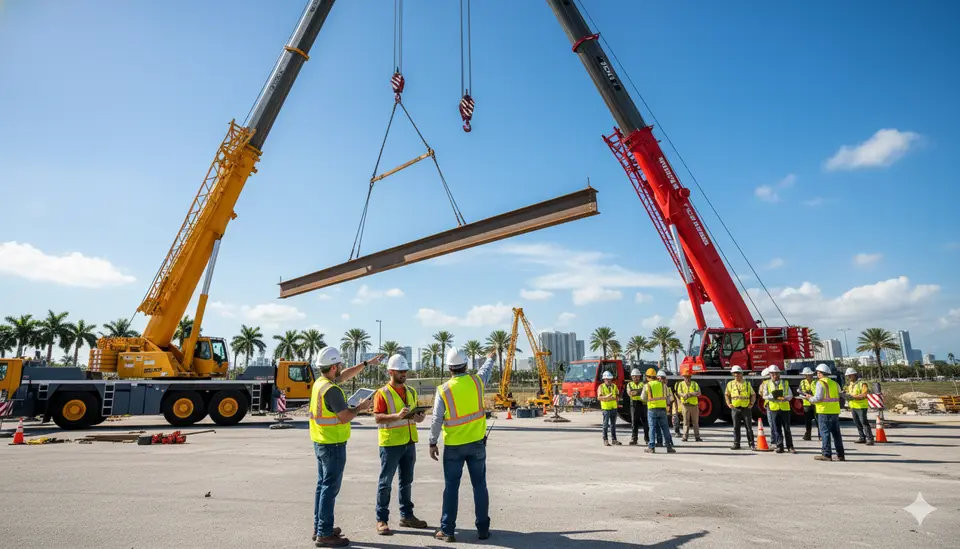
A dual crane lift, often called a tandem lift, uses two cranes to raise and position one load. Crews use it when a load is too heavy or too long for one crane, when it has to be rotated or tilted in the air, or when site layout keeps a single larger crane from reaching the pick.
The technique is common for long precast members, bridge girders, vessels and large equipment. It is also one of the less forgiving operations in the industry. Dual crane operation training is about understanding how the load is shared between machines and how a small mistake by either crane can overload the other.
Why Tandem Lifts Are Harder Than They Look
With one crane, the operator controls the whole load. With two, each crane's share depends on where its hook is attached relative to the load's center of gravity, and that share changes whenever the load tilts, one hook moves faster than the other or one boom drifts out of plumb.
Common hazards include:
- Load transfer: if one crane hoists ahead of the other, more weight shifts to the lower hook.
- Side loading: when hoist lines are not kept vertical, booms see sideways forces that load charts do not account for.
- Swing and travel mismatch: two machines rarely move at exactly the same rate.
- Communication breakdowns: two operators, multiple riggers and one signal plan must stay in sync.
- Center of gravity errors: a wrong estimate puts one crane over its share before anyone realizes it.
What OSHA Requires
In construction, OSHA's crane standard includes a specific section on multiple-crane lifts: 29 CFR 1926.1432. In general terms, it requires:
- A lift plan developed by a qualified person before the work begins
- A pre-lift meeting to review the plan with the people involved
- A lift director assigned to oversee the operation, with the plan implemented under that person's direction
It also ties into the rest of Subpart CC: certified operators (1926.1427), qualified signal persons (1926.1428), qualified riggers and power line clearances. Read the full text at osha.gov (opens in a new tab) and follow any stricter requirements from your employer or the crane manufacturers.
Building a Tandem Lift Plan
A plan for a dual crane pick usually works through these items:
- Load weight and center of gravity, confirmed from drawings or the manufacturer, including rigging weight.
- Each crane's share of the load at every stage, including any rotation or tilting.
- Capacity reductions. Many companies apply a reduction to each crane's chart capacity for tandem work. Use the percentage your company or engineer specifies.
- Crane setup: ground bearing, mat placement, outrigger configuration and radius at pick and set.
- Rigging design: spreader or equalizer beams, slings, shackles and attachment points.
- Sequence of movements written step by step, with hold points.
- Communication plan: who signals, which radio channel, and the stop command everyone uses.
- Contingencies: what happens if wind picks up, a machine faults or a load starts to bind.
Roles on a Dual Crane Lift
Lift director
Oversees the lift, chairs the pre-lift meeting and has authority to stop work. NCCCO offers a Lift Director certification, and The Crane School's instructional staff includes an NCCCO Certified Lift Director.
Crane operators
Each operator must be certified for the crane type they run and must be able to make slow, controlled movements on command. Operators should agree in advance on how they will report load indicator readings.
Signalperson
Usually one designated signal person coordinates both cranes, often by radio. Confusion about who is giving signals is a classic cause of tandem lift trouble. Our signalperson qualification program covers standard hand and voice signals.
Riggers
Riggers attach the load, inspect hardware and keep tag lines manned. Their work determines how the load hangs, which sets each crane's share.
A Field Checklist for Lift Day
Before the pick
- Hold the pre-lift meeting with everyone involved and walk through the written sequence.
- Confirm ground conditions, mats and outrigger setup on both cranes.
- Verify load indicators and limit devices are working on each machine.
- Inspect all rigging and confirm the spreader or equalizer beam rating.
- Check wind and weather against the limits in the plan.
During the pick
- Lift a few inches and hold. Check load indicator readings on both cranes against the plan before going further.
- Keep hoist lines as close to vertical as possible.
- Move one function at a time, slowly, on the signal person's command.
- Stop immediately if readings drift from the plan or anyone loses sight or radio contact.
After the pick
- Debrief: what went as planned, what did not, and what to change next time.
- Record any equipment issues found during the lift.
Training That Prepares You for Tandem Work
There is no shortcut to multi-crane work. Operators earn it by first being solid on single-crane fundamentals: reading load charts, judging radius, feathering controls and responding instantly to signals. Tandem lifts then add coordination drills and supervised experience on real picks.
The Crane School programs that build those foundations include:
- The Initial Mobile Crane Operator Training Program for newer operators, with NCCCO mobile crane exams
- The Mobile Crane Operator Certification Prep Program for experienced operators ready to certify or recertify
- Rigger qualification and certification for the crew that hooks the load
Supervisors who plan these lifts may also benefit from our Managing Crane Safety Class. For more on spotting trouble before it starts, see common mistakes in crane operation.
Talk to Us About Your Crew
If your company has tandem lifts on the schedule, start by making sure operators, riggers and signal persons are certified and qualified. Contact The Crane School to plan training at our Seffner, Florida facility or at your site.
FAQ
Does OSHA require a lift plan for a dual crane lift?
Yes. Under 29 CFR 1926.1432, a qualified person must develop a plan for multiple-crane lifts, a pre-lift meeting must be held, and a lift director must oversee the work.
Can two cranes simply split the load 50/50?
Only if the hooks are positioned so the load's center of gravity sits midway and the load stays level. In practice the share changes as the load moves, which is why planning and capacity margins matter.
Is there a separate NCCCO certification for tandem lifts?
No. Operators certify by crane type. NCCCO does offer a Lift Director certification for the person who oversees lifts, including multi-crane picks.