OSHA Crane Safety Training Courses: Which One Does Your Crew Need?

What "OSHA Crane Safety Training Courses" Really Means
OSHA does not issue crane operator certifications or run its own crane courses for the public. When you see OSHA crane safety training courses advertised, they usually mean training designed to help people meet OSHA's requirements, which are found mainly in 29 CFR 1926 Subpart CC for construction.
That covers a wide range of courses. Some prepare operators for third-party certification exams. Others qualify riggers or signal persons. Some teach supervisors how to manage crane work. And some are general safety awareness classes that mention cranes in passing. Knowing the difference saves time and money.
Course Type 1: OSHA Outreach (10-Hour and 30-Hour)
The OSHA Outreach Training Program offers 10-hour and 30-hour construction courses taught by OSHA-authorized trainers. They cover broad hazard awareness, such as falls, electrical, struck-by and caught-between hazards, and may include a module on cranes.
Good for: general awareness for workers and new supervisors.
Not enough for: operating a crane, rigging, signaling or meeting 1926.1427. An Outreach card is not a crane certification. For more on how these courses fit into construction safety overall, see OSHA compliance training for construction.
Course Type 2: Operator Certification Prep
These courses prepare operators for written and practical exams from an accredited certifier such as NCCCO. They focus on load charts, operating practices, regulations, site setup and hands-on control.
For newcomers
Longer programs with significant seat time. The Crane School's initial mobile crane operator training runs three weeks (telescopic boom cranes, TSS and TLL exams) or five weeks (adding lattice boom and the LAT exam).
For experienced operators
Shorter, exam-focused courses. Our mobile crane certification prep program runs Friday to Monday, with practical exams, classroom review and written exams, for operators ready to certify or recertify.
Other equipment
Articulating boom cranes and telehandlers have their own NCCCO exams and prep courses.
Course Type 3: Rigger and Signal Person Training
OSHA requires qualified riggers for certain work under Subpart CC and qualified signal persons under 1926.1428. Courses in this category teach rigging hardware, sling angles, load weights and inspection of rigging gear, or standard hand and voice signals.
Some courses lead to employer qualification only. Others prepare candidates for NCCCO Rigger Level I or II, or NCCCO Signalperson certification, which is portable. See our rigger qualification and certification program; our signalperson program follows the same model for hand and voice signals.
Course Type 4: Supervisor and Management Training
Supervisors, project managers and safety staff need to understand who is responsible for what: ground conditions, power line planning, inspections, operator evaluation, lift planning and incident prevention. These courses do not teach someone to run a crane. They teach people to manage crane work.
Our Managing Crane Safety Class covers OSHA and industry compliance, preventing accidents, responsibilities, planning, inspections, certification and limiting liability.
Side-by-Side Comparison
| Course type | Who it is for | Leads to | Meets crane-specific OSHA requirements? |
|---|---|---|---|
| OSHA Outreach 10/30 | Any construction worker | Outreach card | No, awareness only |
| Operator certification prep | Current or future operators | Third-party certification exams | Helps meet 1926.1427 certification |
| Rigger training | Riggers, crew members | Qualification or NCCCO Rigger certification | Helps meet qualified rigger requirements |
| Signal person training | Signal persons | Qualification or NCCCO Signalperson certification | Helps meet 1926.1428 |
| Supervisor training | Managers, safety staff | Knowledge and documentation | Supports employer duties |
Open Enrollment or On-Site?
Where the training happens matters as much as what it covers.
Open-enrollment classes bring individuals from different companies together at a training facility. They work well for career changers, independent operators and companies sending one or two people. Students train on the school's equipment and often test at the same location.
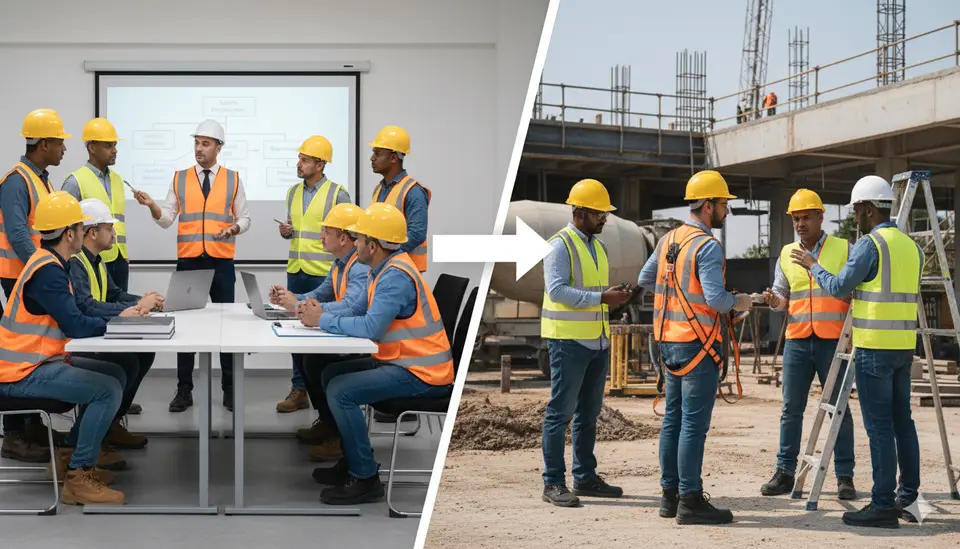
On-site training brings instructors, and often examiners, to your facility. It suits crews of several people, companies that want training on their own equipment and employers who want to reduce travel time. Programs with NCCCO exams can be scheduled at the customer's site anywhere in the country, provided the site meets testing requirements.
Many companies use both: on-site sessions for the crew, and open-enrollment classes for new hires between sessions. Whichever you choose, confirm in advance how exams will be scheduled and what equipment will be used for practical testing.
How to Judge Any Crane Training Provider
Whatever course you pick, ask:
- Who teaches it? Look for instructors with real operating experience and NCCCO credentials.
- How much hands-on time? For operator courses, seat time on real cranes matters.
- What equipment? Train on the crane types you will test on and operate.
- Is testing included? Find out whether written and practical exams are scheduled as part of the program.
- Where is it delivered? Open-enrollment classes work for individuals. On-site training at your facility can be more efficient for crews.
- What happens if you do not pass? Ask about retest policies. The Crane School offers a written-exam guarantee; ask us for details.
Be wary of any provider claiming to issue an "OSHA crane certification." OSHA does not certify operators.
Build a Training Plan by Role
Most crews need more than one course type. A typical plan: operators get certification prep, riggers and signal persons get qualification or certification, supervisors take management training, and everyone gets general awareness. The Crane School can deliver many of these programs on-site anywhere in the country, or at our facility in Seffner, Florida. Contact us to put together a plan.
FAQ
Does OSHA certify crane operators?
No. OSHA sets requirements, and operators meet the certification requirement through options such as an accredited testing organization like NCCCO.
Is an OSHA 10 card enough to operate a crane?
No. Outreach courses provide general hazard awareness. Construction crane operators must meet the certification and evaluation requirements in 1926.1427.
Can crane training be done at our job site?
Yes. The Crane School delivers training and NCCCO exams on-site at customer facilities across the country, as well as at our training facility in Seffner, Florida.