How to Become a Heavy Machinery Operator: A Practical Roadmap

Is This Career a Good Fit?
If you are wondering how to become a heavy machinery operator, start by being honest about the work. Operators spend long days outdoors in heat, cold and rain. Start times are early, projects move, and travel is common. The job rewards focus, patience and a steady hand more than raw strength.
People who do well usually share a few traits:
- They like working with machines and understanding how they behave
- They can concentrate for long stretches without losing attention
- They follow procedures even when nobody is watching
- They communicate clearly with ground crews and supervisors
If that sounds like you, the steps below lay out a realistic path in.
Step 1: Choose the Kind of Machine You Want to Run
Heavy machinery is a broad field. The main families are:
- Earthmoving: excavators, dozers, loaders, graders and scrapers used for site work and roads
- Lifting: mobile cranes, tower cranes, articulating (knuckle boom) cranes and telehandlers
- Material handling: forklifts and telehandlers in yards, plants and warehouses
- Specialty: paving equipment, drilling rigs and pile drivers
Each path has its own training and credential requirements. Lifting equipment, especially cranes, has the most formal certification rules, which also makes certified crane operators easier for employers to evaluate. Our machine-by-machine guide to heavy equipment certification explains those differences.
Step 2: Cover the Basics
Before formal training, most employers and schools expect you to:
- Meet the minimum age for the role and training program
- Have a valid driver's license and government-issued photo ID
- Be able to pass any drug screen or physical the employer requires
- Read and understand written safety material, load charts and manuals
Reliable transportation matters too, since jobsites move and start early. Basic math helps more than most people expect, particularly for crane work where load weights, radius and capacity calculations are part of every lift.
Step 3: Get Formal Training
There are several routes into training. Each has trade-offs.
Apprenticeships
Union apprenticeships combine paid work with classroom instruction over several years. They are competitive and often have limited enrollment windows, but you earn while you learn.
Vocational schools and community colleges
These programs teach a broad heavy equipment curriculum over a semester or more, usually covering several machine types.
Specialized training schools
Focused schools teach one equipment family in depth and prepare you for the related certification exams. This is usually the fastest route to a recognized credential.
At The Crane School, the Initial Mobile Crane Operator Training Program is built for people with little or no experience. The 3-week version covers telescopic boom cranes and NCCCO TSS and TLL exams; the 5-week version adds lattice boom and the LAT exam.
Step 4: Earn the Credentials Employers Ask For
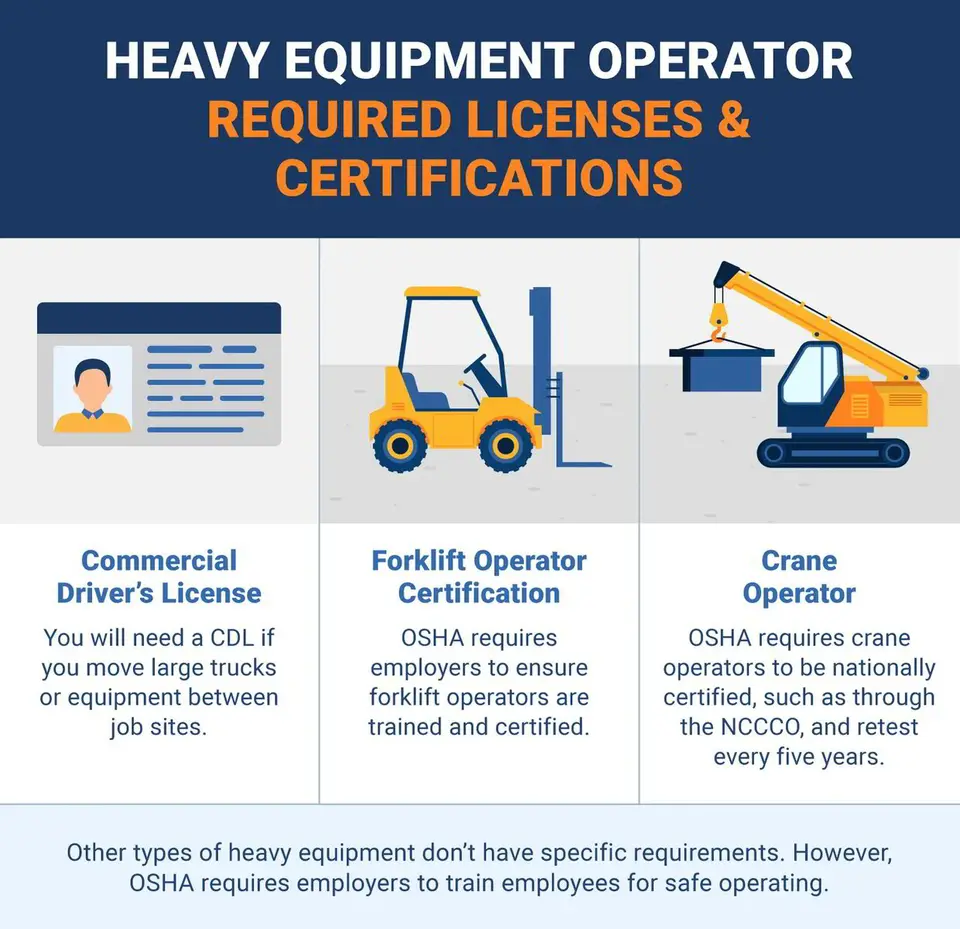
For construction cranes, OSHA 1926.1427 requires operator certification by crane type, and NCCCO is a widely recognized certifying body. For telehandlers and forklifts, OSHA requires employer training and evaluation, and many employers also value the NCCCO Telehandler Operator credential, which our Telehandler Operator Program prepares you for.
Some states and cities have their own crane licensing on top of OSHA. If you plan to work in one of them, confirm current rules with the state agency before you go.
Step 5: Land Your First Job
Your first job is often not in the seat full time. Many new operators start as oilers, riggers, yard hands or apprentice operators, building hours under an experienced operator's eye. Treat that time as part of your training.
To improve your chances:
- Keep copies of every certificate and card in one folder
- Add related credentials such as rigging or signaling so you can contribute on day one
- Show up early, follow site rules and ask questions
- Use job boards and contractor websites, and see our page on crane jobs nationwide
For pay information, check the U.S. Bureau of Labor Statistics Occupational Employment and Wage Statistics for construction equipment operators and for crane and tower operators. Pay varies widely by region, industry and experience.
Mistakes New Operators Should Avoid
A few missteps slow down a lot of new careers:
- Paying for a credential nobody asked for. Check local job postings first so your training matches what employers in your area want.
- Expecting to skip the ground work. Time spent rigging, oiling or spotting teaches you how lifts and sites actually work, and supervisors notice who does it well.
- Treating certification as the finish line. A card proves you passed exams. Employers still watch how you perform on their equipment and their site.
- Letting paperwork lapse. Expired cards, missing medical cards or a suspended driver's license can sideline you overnight.
- Cutting corners to look fast. Smooth and steady beats fast and jerky. Operators who rush are the ones who stop getting called back.
- Not asking questions. Experienced operators generally respect a newcomer who asks before acting rather than guessing.
Avoid these and you will build a reputation that brings steady work.
Step 6: Keep Growing
Operators who keep learning tend to move up: to larger cranes, lift planning, supervision, inspection or training roles. Keep your certifications current, since NCCCO credentials last five years, and add new equipment types over time.
For crane operators, common next steps include adding lattice boom certification, earning rigger and signalperson credentials, and learning lift planning. Some experienced operators eventually move into inspection, safety management or instruction, where years in the seat become the foundation for teaching others.
Start Your Path
If lifting equipment is the direction you want, contact The Crane School. We have prepared students for crane certifications for more than 21 years and can help you choose a program that matches your experience.
FAQ
How long does it take to become a heavy machinery operator?
It depends on the route. Apprenticeships run several years; a focused crane program like our 3-week or 5-week initial training prepares you for NCCCO exams in weeks, though building experience on the job takes longer.
Do I need a CDL to operate heavy machinery?
Not to operate the equipment itself. Employers may require a CDL if you will drive trucks, truck-mounted cranes or haul equipment on public roads.
Does The Crane School train excavator or dozer operators?
No. Our programs focus on cranes, telehandlers, rigging, signaling and crane safety. For earthmoving equipment, look at apprenticeships, vocational schools and dealer training.