Heavy Equipment Certification: A Machine-by-Machine Guide
There Is No Single Heavy Equipment License
People often search for one heavy equipment certification that covers everything with an engine and a seat. It does not exist. In the United States, credentials are tied to specific machine types, and the rules come from different places: federal OSHA standards, a handful of state and city licensing programs, industry certification bodies and individual employers.
Understanding that patchwork saves you from paying for a card that no one on your target jobsite will recognize. This guide walks through the main equipment families, what the rules say about each, and where national certification fits.
Who Sets the Rules
- OSHA sets minimum federal requirements. Some standards, like the construction crane rule, require third-party certification. Others require employer training and evaluation.
- Certification bodies such as the National Commission for the Certification of Crane Operators (NCCCO) give independent written and practical exams and issue portable credentials. NCCCO certifies; it does not train.
- States and cities. Some, including California, New York, Massachusetts and Washington, have their own crane operator licensing on top of OSHA. Confirm current rules with the state agency before you work there.
- Employers and project owners frequently set stricter requirements than the law, such as third-party certification for every operator on a site.
Cranes: Certification Is Required
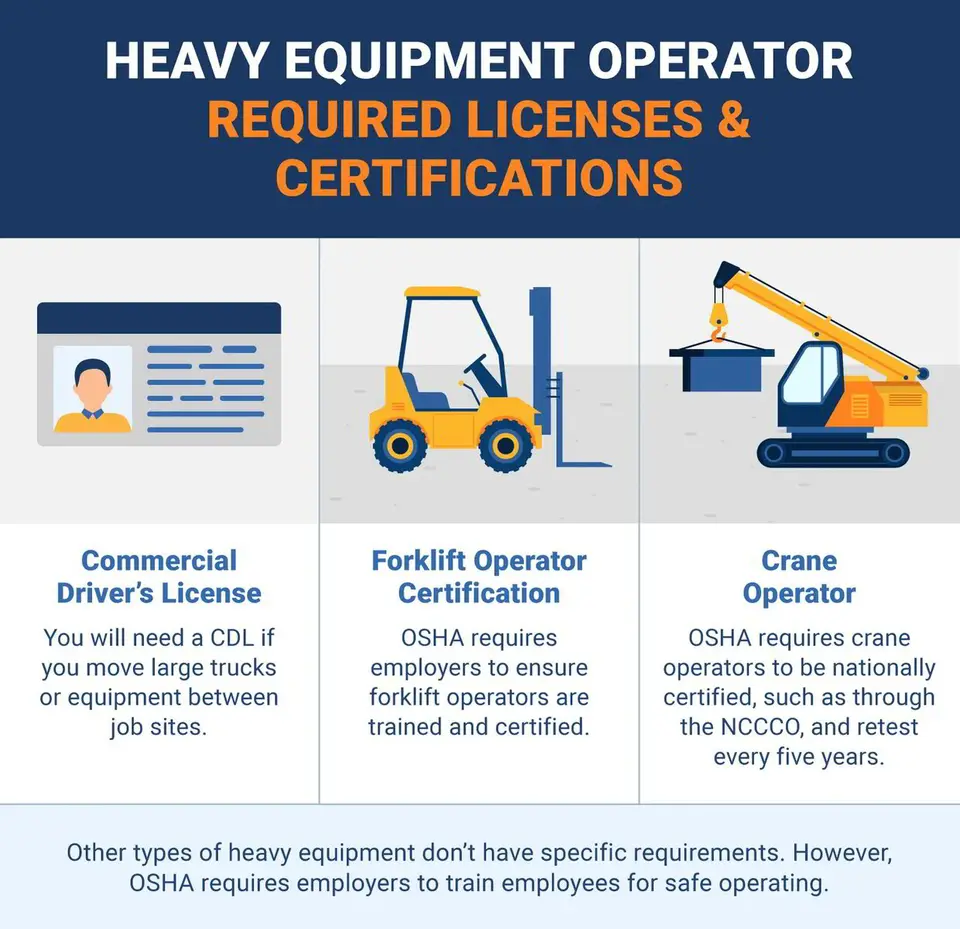
Cranes are where federal rules are strictest. Under OSHA 29 CFR 1926.1427, operators of most cranes used in construction must be certified by an accredited testing organization or qualified through an approved program. Certification is by crane type, and since OSHA's 2018 update it is not tied to capacity.
Common NCCCO crane credentials include:
- Mobile cranes: TSS (telescopic boom, fixed cab), TLL (telescopic boom, swing cab) and LAT (lattice boom crawler and truck)
- Articulating cranes: ABC, ABL and ABW, covering knuckle boom cranes and their loader and winch configurations
- Tower cranes and other specialty categories
Each NCCCO certification is valid for five years. The Crane School prepares candidates for mobile crane exams through the Initial Mobile Crane Operator Training Program for newer operators and a separate prep program for experienced operators, and for articulating exams through our articulating crane certification prep.
Telehandlers and Forklifts: Training and Evaluation Required
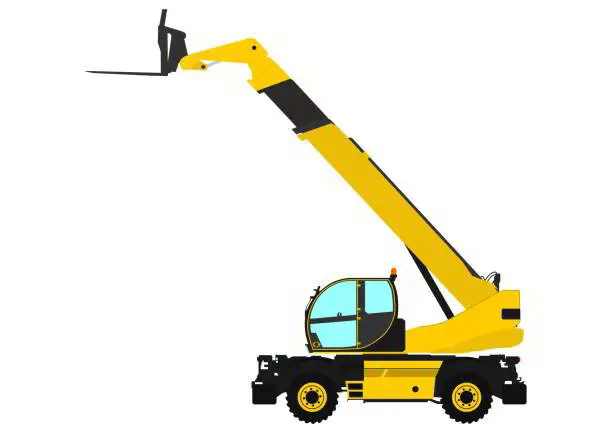
Telehandlers and forklifts are powered industrial trucks under OSHA 1910.178. The rule requires employers to train and evaluate each operator on the type of truck used, then re-evaluate at least every three years. It does not require a third-party card.
Many employers still prefer one. The NCCCO Telehandler Operator (THO) certification gives an independent, portable record of knowledge and skill. Our Telehandler Operator Program prepares candidates for both THO exams. For details on the process, see our NCCCO telehandler certification guide.
Earthmoving Equipment: Employer Qualification
Excavators, dozers, loaders, graders and scrapers do not have a federal certification requirement. OSHA's general construction rules say employers may permit only employees qualified by training or experience to operate equipment and machinery, so the employer decides how to qualify operators.
That qualification usually comes from one or more of these:
- Union apprenticeship programs, such as those run with the International Union of Operating Engineers
- Vocational schools and community colleges that teach a heavy equipment operations curriculum
- Dealer or manufacturer training on specific machines
- Supervised on-the-job experience with documented evaluations
The Crane School focuses on crane-related programs and does not teach earthmoving equipment. If your goal is to run excavators or dozers, look to the options above.
Rigging and Signaling: Qualified People Around the Crane
Anyone who attaches loads or gives signals to a crane operator plays a safety-critical role. OSHA requires qualified riggers for certain construction tasks and qualified signal persons under 1926.1428. NCCCO offers Rigger Level I and II and Signalperson certifications that document those qualifications.
These are useful add-ons even if you mainly run equipment. Our rigger qualification and certification program and signalperson program prepare candidates for NCCCO exams and support a company's qualification process.
Driver Licensing Is Separate
A commercial driver's license is not an equipment operating credential. You do not need a CDL to operate a crane, but an employer may require one if you will drive a truck-mounted crane or haul equipment on public roads. Treat road licensing and equipment certification as two different checkboxes.
How to Plan Your Certifications
- Pick the equipment you want to run and find out what the law requires for it.
- Check job postings in your area. If most mobile crane jobs list NCCCO certification, that is your target.
- Get seat time. Practical exams test skill, so supervised practice comes first.
- Stack related credentials. A crane operator who is also a certified rigger and signalperson is useful in more situations.
- Track expiration dates. NCCCO certifications last five years.
Questions to Ask Before You Pay for Training
Training for a certification is an investment of time and money, so vet the provider first:
- Which exams does the course prepare me for, and are the exam fees included or separate?
- Who gives the practical exam? For NCCCO, an accredited practical examiner scores the test, not just your instructor.
- How much seat time will I get? Practical exams reward smooth, controlled operation, which only comes from practice.
- What happens if I do not pass? Ask about retest options and any published guarantees in writing.
- Is the training current? Rules and exam content change, so materials should reflect current OSHA standards and NCCCO candidate handbooks.
- Can the provider train at our site? Companies with several operators often save time and travel this way.
A clear, written answer to each question is a good sign. Vague promises about guaranteed jobs or instant licenses are a red flag.
Get Help Choosing
Not sure which crane-related credential fits your goals? Talk with The Crane School. We have prepared candidates for crane certifications for more than 21 years and can point you to the right program and exam dates.
FAQ
Is there a national heavy equipment operator license?
No. Requirements depend on the machine. Construction cranes require certification under OSHA 1926.1427, while telehandlers, forklifts and earthmoving equipment rely mainly on employer training and qualification.
Which heavy equipment certification is most recognized?
For cranes, NCCCO certification is widely recognized across the country. For other equipment, recognition varies by employer and region, so check job postings where you want to work.
Does The Crane School offer excavator or bulldozer training?
No. Our programs focus on mobile and articulating cranes, telehandlers, rigging, signaling and crane safety management.
How long does crane certification last?
NCCCO certifications are valid for five years. Recertification adds another five years.