Telehandler Safety Training Courses: What a Good Course Covers
Why Telehandlers Need Their Own Training
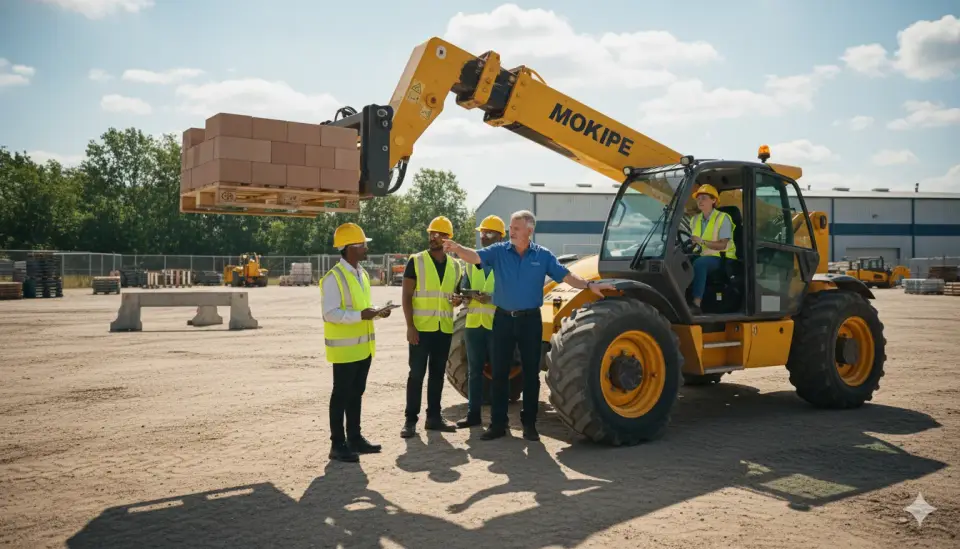
A telehandler looks like a forklift with a long arm, and that resemblance is exactly what gets people hurt. Once the boom goes up and out, the machine's center of gravity moves forward and up, and the capacity you had with the boom retracted can shrink dramatically. A rough-terrain site adds slopes, ruts and soft ground on top of that.
A telehandler safety training course exists to close the gap between driving the machine and understanding it. This post breaks down what a solid course should teach, module by module, so you can judge any class before you enroll yourself or your crew.
If you are looking specifically for the NCCCO credential, start with our guide to NCCCO telehandler certification. This post focuses on course content.
Module 1: Machine Basics and Controls
Good courses start in the operator's manual, not the seat. Trainees should be able to identify:
- Boom sections, the carriage, quick-attach, frame leveling and stabilizers or outriggers
- Joystick functions and how they differ between makes
- Steering modes (two-wheel, four-wheel and crab steer) and when each is appropriate
- Safety devices such as load moment indicators, seat belts, interlocks and alarms
Because controls vary between manufacturers, a course should also teach how to familiarize yourself with a new machine before you run it.
Module 2: Stability and the Load Chart
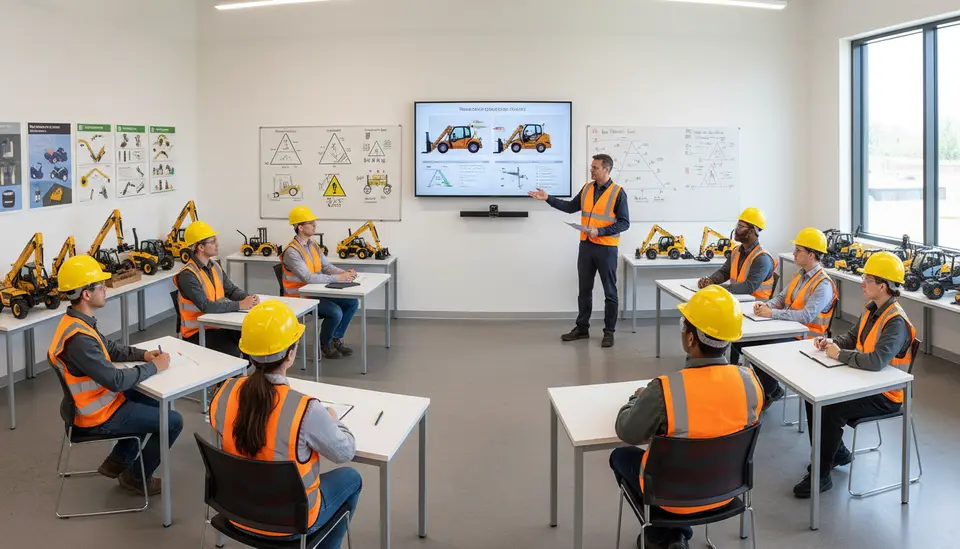
This is the heart of any telehandler course. Trainees should leave able to read a load chart and explain why capacity changes.
What to expect in this module
- The stability triangle: how the machine pivots and how a raised, extended load shifts the combined center of gravity toward tipping.
- Load chart zones: reading capacity by boom angle and extension, and finding the right chart for the attachment in use.
- Frame leveling: why you level the machine before raising a load and never use leveling to compensate on the move.
- Dynamic forces: how jerky controls, wind and travel with a raised load add stresses the chart does not show.
A strong instructor will have trainees work several chart problems by hand before they ever pick a load.
Module 3: Pre-Use Inspection
A course should teach a repeatable walk-around, ideally with a checklist the trainee can take back to work. Typical items include tires and wheel nuts, hydraulic hoses and leaks, boom wear pads and pins, forks and attachment locking pins, fluid levels, lights and alarms, and the condition of the load chart and decals in the cab.
Trainees should also learn the most important rule of inspection: if something is wrong, the machine is tagged out and reported, not run carefully.
Module 4: Attachments and Suspended Loads
Telehandlers can carry forks, buckets, truss booms, jibs and work platforms. Each attachment changes capacity and handling, and each must be approved by the manufacturer for that machine.
A complete course covers:
- Matching the attachment to the correct load chart
- Secure mounting and locking checks
- Restrictions on lifting people, which require an approved platform and the manufacturer's procedures
- When hoisting a suspended load turns the job into crane work, which can bring in OSHA's crane rules and the need for a qualified rigger and signalperson
For that last point, the skills taught in our rigger qualification program carry over directly.
Module 5: Site Hazards and Travel
Many telehandler incidents happen while traveling, not lifting. The course should drill:
- Traveling with the boom low and retracted
- Driving up and down grades the way the manufacturer specifies, especially when loaded
- Watching for soft ground, trenches, edges and overhead power lines
- Managing blind spots, using spotters and keeping pedestrians out of the swing and travel path
- Weather limits, including wind when the boom is extended
Module 6: Hands-On Practice and Evaluation
OSHA's powered industrial truck standard, 1910.178(l), expects training to combine formal instruction, practical training and an evaluation of the operator's performance in the workplace. A course that is all video and no seat time does not meet that expectation on its own.
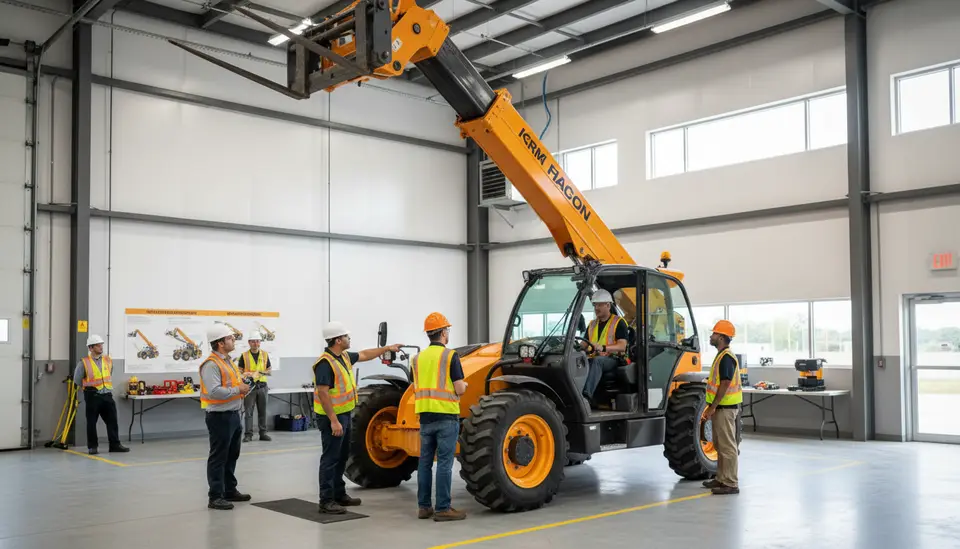
The practical portion should include placing loads at height, threading forks into pallets, working near obstructions and following hand signals. Instructors should coach smooth control inputs and give clear feedback on each run.
Signs a Course Is Worth Your Time
Before you sign up, ask the provider a few direct questions. The answers tell you a lot about what you will get.
- How much of the course is in the seat? Look for a clear split between classroom and supervised operation, not a vague promise of hands-on time.
- Who teaches it? Instructors should have real operating experience and current credentials, and they should be able to explain load chart problems, not just read slides.
- What machine will I train on? A reach and capacity similar to what you run at work makes practice more useful.
- How is performance evaluated? You want an evaluator who watches you complete defined tasks and gives specific feedback, plus written records your employer can file.
- Does it end with an independent exam? If you want a portable credential, ask whether the course prepares you for the NCCCO THO written and practical exams.
- Can it come to us? For crews, training at your own yard means practicing on familiar ground and equipment.
A provider that answers these clearly and in writing is usually one that runs a disciplined class.
How Long a Course Should Take
Course length depends on who is in the room. Experienced operators preparing for a credential may need a focused review and practice. New operators need more seat time and more coaching. Be wary of a class that promises the same short format for everyone.
At The Crane School, the Telehandler Operator Program prepares candidates for the NCCCO THO written and practical exams, and we can deliver it at your facility for groups. To compare course formats side by side, read our telehandler training comparison guide.
Book Training for Your Crew
Want a telehandler course that covers these modules and ends with an NCCCO exam? Reach out to our team to talk through dates, group size and on-site options.
FAQ
What is the most important topic in a telehandler safety course?
Stability and load chart reading. Most serious telehandler incidents trace back to misjudging capacity as the boom is raised and extended, or traveling with a raised load.
Is online-only telehandler training enough?
Not by itself. OSHA 1910.178(l) calls for practical training and an evaluation of the operator's performance, so classroom or online content has to be paired with supervised hands-on work.
Does a telehandler course cover lifting people?
A good course covers the restrictions: only manufacturer-approved work platforms, used under the manufacturer's procedures. Using forks or a pallet to lift a person is never acceptable.