IOSHA, Subpart CC and the Indiana Operator
Hoosier job sites answer to IOSHA, a state-administered program with federal OSHA approval. Any state plan has to protect workers at least as well as the federal rules, so for construction cranes Indiana follows the structure of 29 CFR 1926 Subpart CC, including accredited operator certification in section 1926.1427. If you think an Indiana-specific amendment might touch your job, IOSHA is the place to ask.
Since the state doesn't stack a license on top, Indiana crane certification comes down to passing accredited written and practical tests, and NCCCO is the program most employers know. We handle preparation; NCCCO runs the exams and issues the card.
The card is only half of what the rule expects, though. Your employer also has to evaluate you on the particular crane you'll run and make sure you're trained on any machine that's new to you. Certification proves you passed an accredited test; the employer's evaluation proves you can handle their crane on their site. An Indiana crane program needs both.
Steel, Limestone, RVs and the Crossroads of America
Indiana industry gives cranes work in every season. Up in the northwest corner, the Lake Michigan steel mills schedule big outage and maintenance lifts. The northern counties are famous for building recreational vehicles, and auto plants and parts suppliers operate statewide. Down south, limestone quarries have shipped building stone for generations.
Around Indianapolis, the interstate web behind the "Crossroads of America" nickname drives a constant flow of distribution centers, bridges and general construction. Grain handling and farm operations put lifting equipment to work in rural counties too.
An operator might go from a covered mill bay one month to an open quarry floor the next, so the setup and communication skills an Indiana employer needs vary widely.
What Indiana Customers Have Said
We have taught on-site for Indiana companies. Here is how Martin Lewis of Lewis Signs in Indianapolis put it: “The experience the instructor had in operating cranes for a lot of years really showed us that he is very knowledgeable and has the ability to communicate.”
Sign crews show why training on your own trucks pays off. They frequently work articulating cranes or boom trucks in cramped spots next to traffic and overhead lines, where practice on the real machine counts.
Training Options for Indiana Employers and Individuals
With on-site training, our instructors travel to your Indiana yard, plant or project and teach on the equipment you already own. NCCCO Accredited Practical Examiners on our staff can test your operators right there, and mills and factories often line the dates up with a planned outage when crews are free.
For open enrollment, students come to our sole campus in Seffner, Florida, east of Tampa. NCCCO written testing happens monthly, and both the certification weekend and the longer beginner courses follow our posted schedule of classes. Most Indiana students fly into Tampa International.
Large plants and mills should sort out early whether their crane work counts as construction, general industry or a mix. Installing new equipment during an expansion is construction and falls under Subpart CC, while routine production lifts usually sit under general industry. Plenty of Indiana employers certify to the construction standard anyway so one crew can cover both.
Matching Indiana Crews to Programs
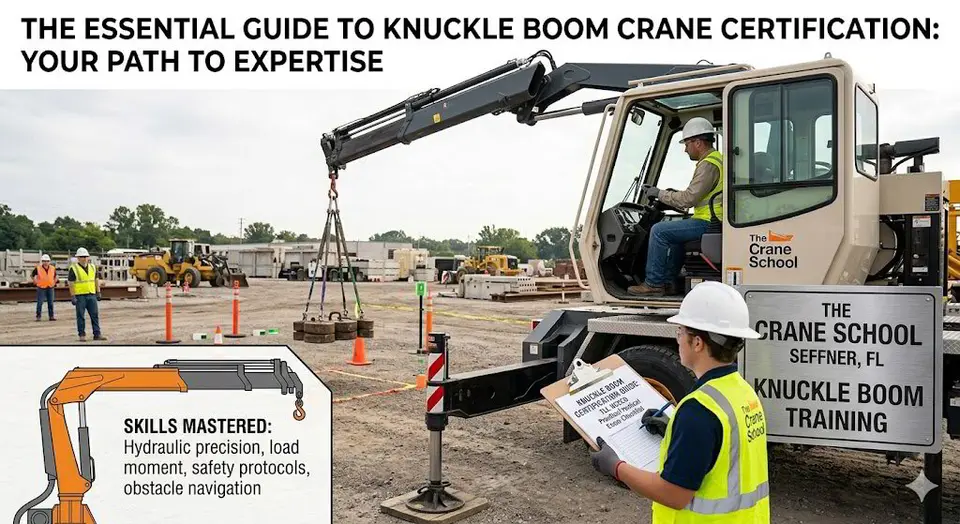
- Knuckle boom truck crews in signs, utilities and building supply: our articulating crane certification prep for the NCCCO ABC, ABL and ABW exams.
- Experienced mill and construction operators: the prep course for certifying mobile crane operators, built around TSS, TLL and LAT.
- Safety staff and plant supervisors: the crane safety course for managers, dealing with OSHA compliance, lift planning, inspections and responsibilities.
Anyone without seat time should begin with the 3-week or 5-week beginner mobile crane course. For more on the articulating tests, read our guide to knuckle boom crane certification.
Growing a Crane Career in Indiana
Holding several certifications lets an Indiana operator shift between factories, construction and niche work such as utilities and signs. Lots of people begin on a boom truck and graduate to bigger mobile cranes, or step up from rigging into the cab.
For wages, rely on the BLS occupational wage survey for crane and tower operators (53-7021), which breaks out Indiana and its metro areas. Your certification expires after five years, so put that date on the calendar early.
Manufacturers in the north, contractors around the middle of the state and quarries and river towns in the south all need different crane skills. An operator trained on more than one type can go where the jobs are rather than waiting for them.