Myth vs. Fact: Debunking 5 Common and Dangerous Misconceptions in the Crane Industry
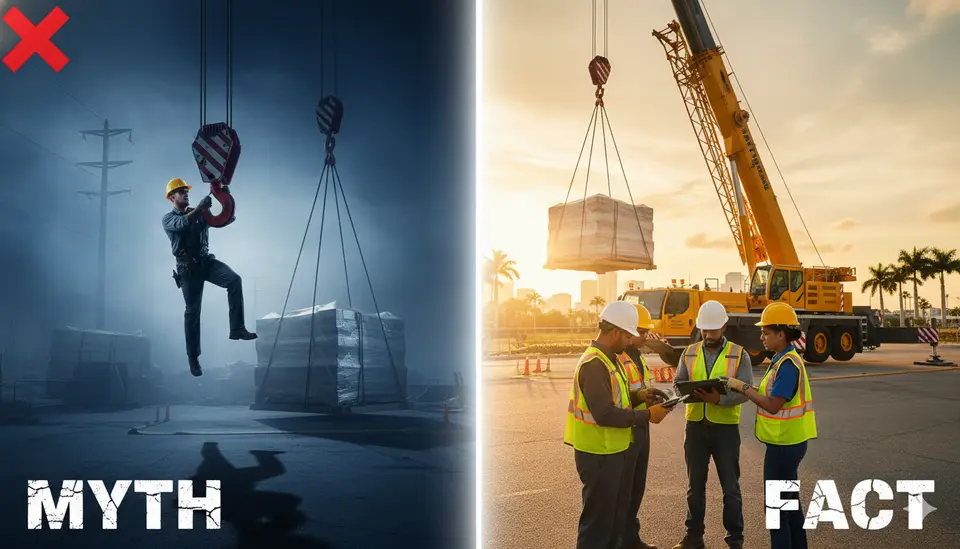
Why Myths Spread in Skilled Trades
Every trade passes down shortcuts and rules of thumb. Many are useful. Some are not. In crane work, where physics is unforgiving, a myth repeated often enough can start to sound like a rule. That leads to damaged equipment, injuries and incidents that never needed to happen.
Professional operators and riggers base their decisions on engineering data, regulations and an understanding of why each practice exists. Below are five crane safety myths we run into regularly, along with the facts.
Myth 1: "A Little Load Swing Is Normal and Cannot Be Helped"
The myth: Loads sway or spin in the air. That is just part of lifting, and the tagline handlers will deal with it.
The fact: Significant, uncontrolled swing is usually caused by how the crane is operated, and it is a hazard. It adds dynamic loading to the crane and rigging, can push the load outward and increase radius, and puts people and property at risk.
Common causes
- Abrupt control inputs: starting or stopping swing or hoist suddenly turns the load into a pendulum.
- Hook not centered: if the hook is not directly over the load's center of gravity, the load shifts as it leaves the ground.
- Swinging too fast: aggressive acceleration and deceleration is the most common cause.
How professionals control it
- Feather the controls with small, smooth inputs.
- Check the swing by easing in a small counter-motion near the stopping point to cancel momentum.
- Use taglines for fine adjustments, not to wrestle a swinging load.
Myth 2: "If the LMI Is in the Green, the Lift Is Safe"
The myth: The load moment indicator, or rated capacity indicator, knows everything. If it is not alarming, the lift is fine.
The fact: The LMI is an important operator aid, but it measures only a few things, and only accurately if the configuration was entered correctly. It cannot see:
- Ground conditions under the outriggers or tracks
- Wind acting on the load, unless the system includes a sensor and even then not the load's sail area
- Rigging condition, such as a damaged sling or shackle
- Load integrity, including weak pick points
- People and hazards such as power lines or workers entering the swing radius
The operator still has to plan the lift, verify weights and watch the whole environment. Learn more about how these systems work in our post on crane safety devices. Supervisors can explore this holistic approach in the Managing Crane Safety Class.
Myth 3: "Shorter Slings Are Safer Because the Load Stays Low"
The myth: Short slings keep the load closer to the hook and the ground, so they are more stable.
The fact: Short slings on a wide load create flat sling angles, and flat angles multiply the tension in each leg. For a two-leg bridle with a load shared equally:
- At 90 degrees (vertical legs), each leg carries 50 percent of the load.
- At 60 degrees from horizontal, each leg carries about 57.7 percent.
- At 30 degrees, each leg carries 100 percent of the load.
So two slings each rated for 10,000 pounds, lifting a 10,000-pound load at a 30-degree angle, are each loaded to their full rating. Qualified riggers aim for sling angles of 60 degrees or more and choose sling lengths to achieve them. Our rigger qualification program covers these calculations in depth.
Myth 4: "Certification Is Just Paperwork, Real Learning Happens on the Job"
The myth: You get certified to get hired. The real education starts in the field.
The fact: Experience is essential, but formal training and certification give you the foundation that experience builds on. Field training often teaches how to do something. Formal education teaches why: why the load chart is structured the way it is, why a specific component fails, why a procedure exists. That understanding is what lets an operator make good decisions in situations they have never seen before.
Think of certification as the start of a higher level of learning. CCO certifications last five years, and the best operators use each recertification as a chance to sharpen their knowledge. See our post on continuous learning for crane operators.
Myth 5: "A Little Damage to Rigging Is Normal Wear and Tear"
The myth: Gear gets banged up. A small kink, a nick in a synthetic sling or a slightly bent latch is part of the job.
The fact: Rigging hardware and slings have objective removal criteria, set out in OSHA rules and ASME B30 standards, and damaged gear must come out of service. Examples include:
- Wire rope slings: OSHA's construction rule calls for removal at ten randomly distributed broken wires in one rope lay, or five broken wires in one strand in one rope lay, along with kinking, crushing, birdcaging or heat damage.
- Synthetic slings: acid or caustic burns, melting or charring, holes, tears, cuts or snags, broken or worn stitching, or a missing or unreadable tag.
- Hooks: cracks, twisting, an increased throat opening or excessive wear beyond the limits in ASME B30.10, or a missing or damaged latch where one is required.
When in doubt, take it out of service and have a qualified person decide.
Build Your Career on Facts
Myths survive because they sound reasonable and save a little time. Facts keep crews safe. A good place to start replacing guesswork is the math behind every lift, covered in our post on crane load calculations. If you want training built on regulations, engineering principles and real operating experience, explore our training programs or contact The Crane School.
FAQ
Is a lift safe if the load moment indicator shows no warning?
Not necessarily. The LMI does not account for ground conditions, wind on the load, rigging condition or nearby hazards, and it depends on correct configuration input.
What sling angle is recommended?
Riggers generally aim for 60 degrees or more from horizontal. Flatter angles sharply increase the tension in each sling leg.
Can slightly damaged rigging still be used?
No. If gear meets any removal criteria in OSHA rules, ASME standards or the manufacturer instructions, it must be removed from service.