Top Crane Training Programs for Safety Excellence: What to Look For
Why "Safety First" Needs Proof
Every training provider promises safety. The difference shows up in the details: who teaches, how much time you spend at the controls, what the curriculum covers and how the program handles mistakes. A safety-focused crane training program builds habits that protect you long after the exam.
The scorecard below gives you eight areas to evaluate. Use it to compare providers side by side, whether you are an individual choosing a school or an employer selecting training for a crew.
1. Instructor Experience and Credentials
Instructors shape everything. Look for:
- Years of real operating experience, not just classroom teaching
- NCCCO certifications in the areas they teach
- Examiner, inspector or rigging credentials that show depth beyond operating
- Ability to explain the why behind procedures, not just the steps
At The Crane School, instructional staff credentials include NCCCO certified crane operators, riggers, signalpersons, inspectors and a lift director, along with NCCCO accredited practical examiners.
2. Real Seat Time on the Right Equipment
Ask exactly how many hours you will spend at the controls, on which crane types, and how many students share each machine. Then compare that to the exams you plan to take. Telescopic boom, lattice boom and articulating cranes each require their own practice.
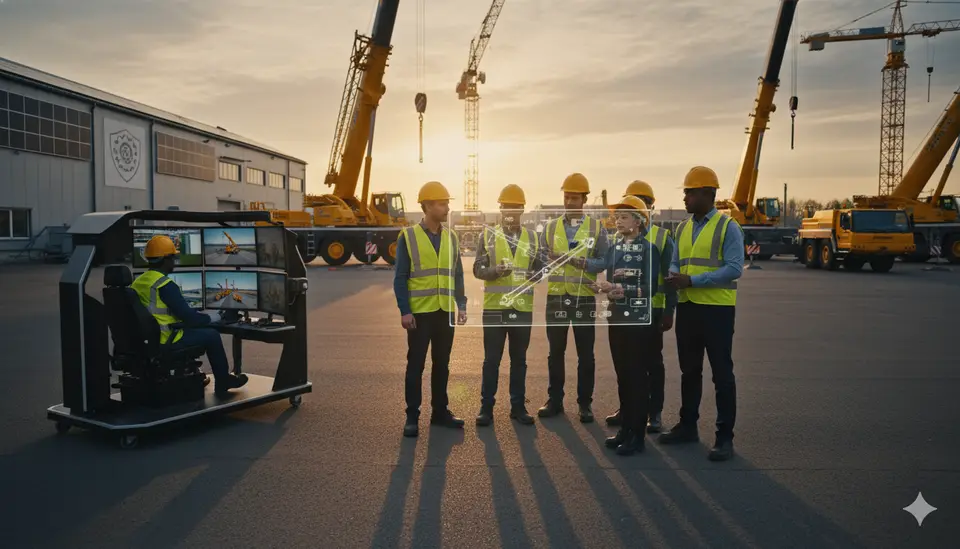
Simulators and videos can help, but safe control habits are built on real machines. Our post on crane simulator training explains why.
3. A Curriculum Built Around Hazards
A safety-focused curriculum spends real time on the topics behind most incidents:
- Pre-operational inspections and when to remove a crane from service
- Setup and ground conditions, including mats and outrigger use
- Load charts and calculations, including rigging weight and deductions
- Power line safety under OSHA 1926.1408
- Signals and communication, including the emergency stop
- Rigging basics, such as sling angles and hardware inspection
- Weather limits and when to shut down
- Emergency response for failures and power line contact
If a course outline is mostly about passing a test, ask how these topics are covered in practice.
4. Alignment With NCCCO Exams
Training should clearly prepare you for specific NCCCO written and practical exams, such as TSS, TLL and LAT for mobile cranes, ABC, ABL and ABW for articulating cranes, THO for telehandlers, or Rigger and Signalperson certifications. Ask:
- Which exams are included and when they are scheduled
- Whether exam fees are part of the price
- What support is available if you need to retest
The Crane School offers CCO written exams every month at its Seffner, Florida headquarters and publishes a written-exam guarantee in its FAQ.
5. Training Format and Class Structure
Consider whether the format fits your experience:
- Beginners need longer programs with more seat time, such as our 3-week and 5-week Initial Mobile Crane Operator Training Program.
- Experienced operators may only need focused prep before exams, like the mobile crane certification prep program.
- Employers may prefer onsite training for crews.
Also ask about class size and how instructors give individual feedback.
6. Equipment Condition and Practice Area
Training equipment should be inspected and maintained, with working operator aids. The practice area should be laid out safely, with barricades and no overhead power lines. If a school's own yard is not run safely, that is a warning sign about what it teaches.
7. How Mistakes Are Handled
Ask how instructors respond when a student makes an error. In a strong program, mistakes are stopped immediately, explained calmly and practiced again. Students should feel free to ask questions and to stop a lift when unsure. That is the same culture you want on a job site.
8. Support Beyond the Class
Look for providers that help after the course:
- Recertification training as your five-year expiration approaches
- Additional credentials such as rigging, signalperson or telehandler
- Training for supervisors, such as the Managing Crane Safety Class
- Practice time available when you need to sharpen skills before a practical exam
Warning Signs to Watch For
While you compare programs, some answers should give you pause:
- The provider cannot tell you how many hours you will spend at the controls.
- Instructors' credentials are vague, or nobody can tell you who will teach.
- The course promises certification with no mention of NCCCO written and practical exams.
- Safety topics like power lines and emergency response are covered "as time allows."
- Students are rushed through practical tasks to stay on schedule.
- There is no clear answer about what happens if you do not pass.
One warning sign is not always a deal breaker, but several together suggest a program focused more on throughput than on safe operators.
Extra Questions for Employers
If you are choosing training for a crew, add these to your list:
- Can training be delivered at our facility, on our equipment?
- Can practical exams be scheduled on site?
- How will you document each participant's training for our records?
- Can you combine operator, rigger and signalperson training in one engagement?
- Do you offer training for supervisors who plan lifts?
Putting the Scorecard to Work
Rate each provider from 1 to 5 in all eight areas, then compare totals alongside price and schedule. A slightly higher price for much more seat time or stronger instructors is often the better value. Our post on affordable crane safety training explains how to compare true costs.
Visit, Ask and Decide
The best way to judge a program is to ask detailed questions and, if possible, see the training yard. Contact The Crane School with your questions, or review upcoming dates on the class schedule.
FAQ
How much hands-on time should crane training include?
It depends on your experience and the exams you are taking. Beginners need substantial seat time on each crane type, while experienced operators may need targeted practice on exam tasks. Always ask for specific hours.
Do crane schools issue NCCCO certifications?
No. Schools provide training and may host exams, but NCCCO issues the certification after you pass the written and practical exams.
What topics should a safety-focused crane course cover?
Inspections, setup and ground conditions, load charts, power line safety, signals, rigging basics, weather limits and emergency response.