Choosing Knuckle Boom Crane Training in Florida: What to Look For
Why Criteria Beat Rankings
If you search for knuckle boom crane training in Florida, you will find lists that rank schools with little explanation. A ranking cannot tell you whether a program fits your experience, your schedule or the work you do. Clear criteria can.
This guide gives you the questions to ask any provider, including us. Use them to compare options side by side and pick training that ends with a credential employers recognize.
Florida Context: What the Rules Require
Florida does not run its own statewide crane operator licensing program the way some states do. For construction work, federal OSHA rules apply, including operator certification by crane type under 29 CFR 1926.1427. Articulating cranes are covered by OSHA's construction crane standard, with a narrow exclusion for some delivery-only work.
Employers and general contractors may set stricter requirements, and some local jurisdictions or project owners add their own. Confirm what your employer and project require. For a deeper look, see our post on crane operator certification requirements in Florida.
Criterion 1: Which Exams Does the Program Prepare You For?
Knuckle boom certification through NCCCO comes in three designations: ABC (articulating boom crane), ABL (articulating boom loader) and ABW (articulating boom crane with winch). Ask:
- Which designations does the course cover?
- Are the written and practical exams included, or do I schedule and pay for them separately?
- How soon after training can I test?
A program that cannot clearly name the exams it prepares you for is a warning sign. Remember that NCCCO issues the certification; schools prepare you for it.
Criterion 2: Who Teaches and Who Examines
Ask about the people behind the program:
- Do instructors have real operating experience on articulating cranes?
- Do they hold NCCCO certifications themselves?
- Are NCCCO accredited practical examiners on staff, or does the school bring one in?
Having accredited examiners on staff can make scheduling the practical exam simpler, especially for groups.
Criterion 3: Seat Time and Equipment
Practical exams reward smooth, controlled operation, and that only comes from practice. Find out:
- How many hours each student spends at the controls
- What crane will be used for practice and testing, and how it compares to what you run at work
- Whether practice includes setup, stabilizers and leveling, not just moving loads
If you are brand new to cranes, be honest about it. Articulating crane prep courses are usually designed for people who already have knuckle boom experience. Newcomers may need a foundation program first, such as the Initial Mobile Crane Operator Training Program, and supervised experience before testing.
Criterion 4: Curriculum Depth
A solid curriculum covers more than how to pass. Look for:
- Load chart interpretation for each configuration and attachment
- Pre-use inspection and documentation
- Power line safety, a serious concern given how many overhead lines run along Florida streets and job sites
- Weather awareness, including afternoon thunderstorms and lightning, wind limits and hurricane season preparation
- Working with a qualified signal person and basic rigging
Ask to see a course outline. A good provider will share one.
Criterion 5: Schedule, Location and On-Site Options
Consider how training fits your life or your company's workload:
- Are classes scheduled regularly, and how far out are they booked?
- Can the provider come to your yard so crews train on familiar equipment?
- If you travel, is lodging nearby and are there arrangements with local hotels?
For Florida companies with several operators, on-site training often costs less in lost production than sending people away.
Criterion 6: Transparency on Cost and Outcomes
Get a written quote that lists training, exam fees, practice time and any retest costs. Ask what happens if you do not pass. Be skeptical of guaranteed job placement or promises of a certification without testing. Reputable providers explain what is included and what is not.
Red Flags to Watch For
A few warning signs should make you look elsewhere:
- A card with no independent exam. If the only evaluator is the person who sold you the course, the card may not satisfy employers who ask for NCCCO certification.
- No seat time. A classroom-only or online-only course cannot prepare you for a practical exam.
- Vague answers about examiners. You should know who will score your practical and how it is scheduled.
- Guarantees of jobs or wages. No school controls hiring decisions or pay. For wage information, look at U.S. Bureau of Labor Statistics data.
- Pressure to sign up immediately. Good programs are happy to send an outline and let you compare.
Ask for everything in writing and keep it with your training records.
A Quick Comparison Worksheet
When you have two or three programs in mind, put the answers side by side. For each provider, write down:
- NCCCO designations covered (ABC, ABL, ABW)
- Exam fees included or separate
- Instructor and examiner credentials
- Hours of seat time per student
- Crane model used for practice and testing
- Next available dates, and whether on-site training is offered
- Total cost, including retests and any travel or lodging
Seeing the answers in one place makes the differences obvious, and it gives you a record to share with an employer who may be paying.
How The Crane School Measures Up
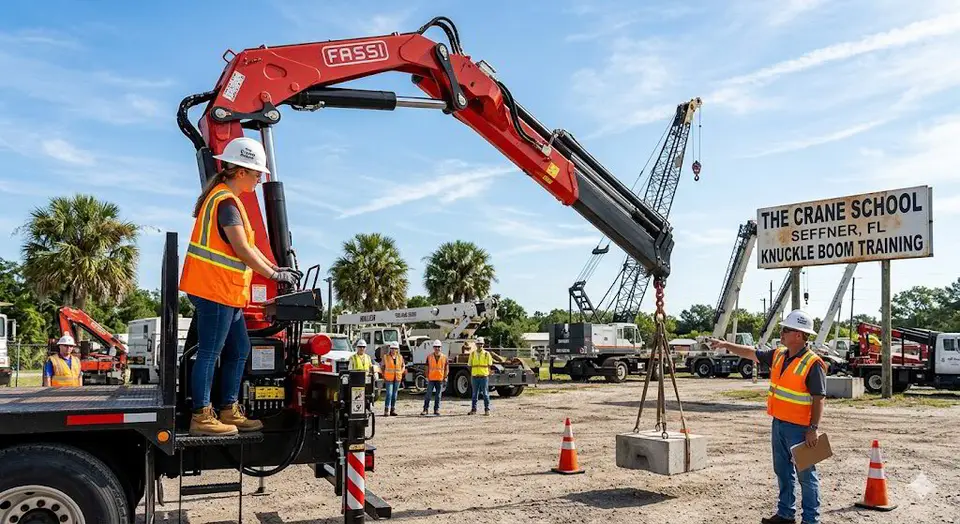
Use the same checklist on us. The Crane School is based in Seffner, east of Tampa, and has prepared candidates for crane certifications for more than 21 years. Our Articulating Crane Operator Certification Prep Program prepares operators with knuckle boom experience for the NCCCO ABC, ABL and ABW written and practical exams. Our staff includes NCCCO certified operators and accredited practical examiners for articulating cranes.
CCO written exams are offered monthly at our Seffner headquarters, practical exams can be scheduled nationwide, and we offer on-site training for companies. For exam preparation advice, read our articulating crane exam prep guide.
Ready to compare? Contact us for a course outline and current dates.
FAQ
Does Florida have its own crane operator license?
Florida does not run a statewide crane operator licensing program like some states. Federal OSHA certification rules apply to construction work, and employers or project owners may add requirements.
Do I need experience before knuckle boom certification training?
Most articulating crane prep courses, including ours, are designed for people with knuckle boom experience. If you are new, plan on foundation training and supervised seat time first.
Can a training provider come to my Florida job site?
Many can. The Crane School provides on-site training for companies and can schedule NCCCO practical exams at your location.