Rigging Certification Requirements in Florida: What Actually Applies
Short Answer: Federal Rules, Plus Your Contract
People often expect a state license for rigging. Florida doesn't have one. The rigging certification requirements in Florida come from three layers:
- Federal OSHA, which covers private-sector construction in Florida.
- Your employer's policies, which can be stricter than OSHA.
- Project and owner requirements, written into contracts and site safety plans.
Understanding which layer is asking for what saves you from paying for the wrong class or showing up with the wrong paperwork.
Layer 1: Federal OSHA
OSHA's crane standard, 29 CFR 1926 Subpart CC, applies to construction cranes in Florida just as it does elsewhere. For riggers, the key sections are:
- 1926.1404, which requires a qualified rigger during crane assembly and disassembly.
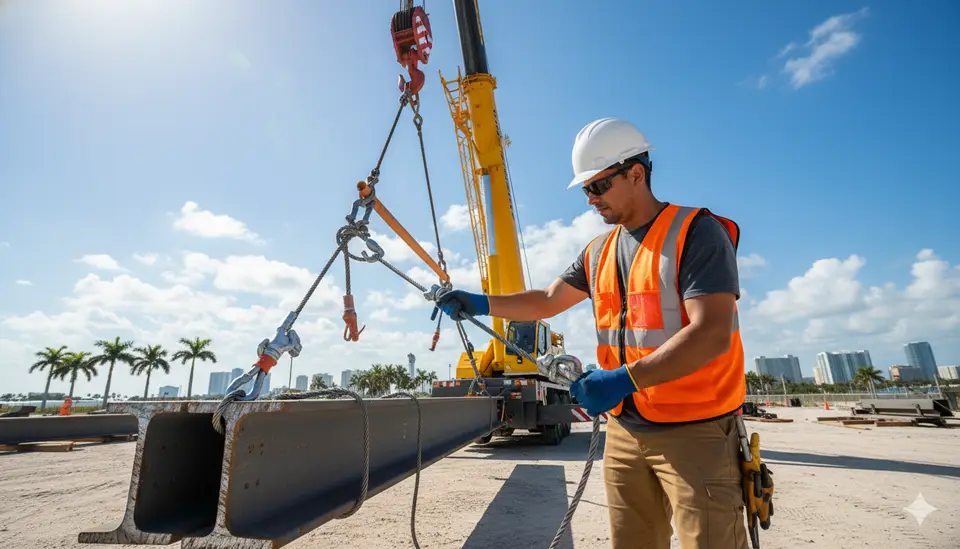
- 1926.1425, which requires that loads be rigged by a qualified rigger when workers are in the fall zone hooking, unhooking, guiding or making an initial connection.
- 1926.251, which covers inspection, capacity and removal from service for slings and rigging hardware.
OSHA uses the word qualified, not certified. A qualified rigger is someone the employer can show has the knowledge, training and experience to do the work. Certification is one way to document that, but OSHA does not mandate it.
Layer 2: Your Employer
Because OSHA leaves the qualification decision to employers, many Florida companies set their own standard. Common approaches include:
- An internal qualification process, often built around a training class plus a practical evaluation.
- Requiring NCCCO Rigger Level I for anyone who rigs, and Level II for leads or those planning more complex lifts.
- Requiring both rigger and signalperson credentials for crane crew members.
If you are applying for jobs, ask what the company expects. If you are an employer, write the standard down and keep the documentation where a site inspector can find it.
Layer 3: Project and Owner Requirements
Large Florida projects, including industrial facilities, ports and commercial high-rise work, often carry owner or general contractor safety requirements stricter than OSHA. NCCCO certification for riggers and signalpersons is a common line item, because it is third-party and portable.
The practical effect: even if your employer qualifies you internally, you might not be allowed to rig on a particular site without NCCCO certification. Check the site safety plan before mobilizing.
Florida Conditions That Shape Rigging Work
Federal rules don't change at the state line, but Florida's conditions do affect how riggers work:
- Wind and storms. Afternoon thunderstorms and hurricane season call for close attention to wind on large-surface loads and a clear plan for stopping work.
- Heat and sun. Synthetic slings can be damaged by heat, and UV exposure can degrade them over time. Inspection matters.
- Coastal corrosion. Salt air speeds up corrosion on wire rope and hardware near the coast, which makes pre-use inspection even more important.
None of these are separate legal requirements, but rigging courses taught in Florida should address them.
Who Checks Your Paperwork
On a Florida site, more than one person may ask to see proof that you are qualified or certified:
- Your foreman or crane supervisor, before assigning you to rig.
- The site safety manager, during orientation or audits.
- The general contractor or owner's representative, if the project has its own credential requirements.
- An OSHA compliance officer, during an inspection or after an incident.
Keep a copy of your NCCCO card or your employer's qualification record where you can produce it quickly. The MyCCO app shows NCCCO certification status, which helps when a supervisor needs to verify on the spot.
Keeping it current
NCCCO certifications last five years. Florida employers that rely on certification usually track expiration dates, but the responsibility to recertify is yours. Start in the last year before your card expires.
Getting Certified in Florida
NCCCO offers Rigger Level I and Rigger Level II certifications, and each requires a written exam and a practical exam. The Crane School, based in Seffner just east of Tampa, prepares candidates for both levels:
- CCO written exams are offered every month at the Seffner headquarters.
- Practical exams can be scheduled with the school's NCCCO accredited practical examiners, in Seffner or on-site anywhere in the country.
- Class options include the 2-Day Rigger Qualification Class at $425 and the three-day Rigger Only Certification with Practical at $1,375.
Details are on the Rigger Qualification and Certification Program page. For an in-depth look at what NCCCO expects at each level, read our guide to rigger certification requirements.
For Florida Employers
If you run crews, a few habits make compliance simpler:
- Decide in writing whether your company qualifies riggers internally, requires NCCCO certification, or uses a mix by role.
- Keep qualification records and certification copies at each site, not only at the office.
- Train signalpersons alongside riggers, since OSHA 1926.1428 has its own qualification rule for anyone giving signals.
- Schedule on-site training so crews learn on the gear they actually use. The Crane School delivers programs at client facilities anywhere in the country.
Working Outside Florida
If your work takes you out of state, remember that some states and cities have their own crane-related licensing in addition to OSHA, and some of those rules touch rigging. Before you work in another state, confirm current rules with that state's agency and NCCCO's state licensing information. A portable NCCCO certification is often the easiest way to meet requirements as you travel.
Talk to Us
Not sure whether you need qualification or certification for your next Florida job? Contact The Crane School or call (813) 402-2017, Monday through Friday, 7:00 AM to 4:00 PM.
FAQ
Does Florida have a state rigger license?
No. Florida does not issue a state rigger license. Federal OSHA rules apply to construction rigging, and employers or projects may require NCCCO certification.
Is an employer-qualified rigger legal in Florida?
Yes, under federal OSHA the employer can determine that a rigger is qualified. Some sites still require NCCCO certification.
Where can I take NCCCO rigger exams in Florida?
CCO written exams are offered monthly at The Crane School in Seffner, and practical exams can be scheduled with its accredited practical examiners.