Understanding OSHA Crane Training Standards: A Role-by-Role Comparison
Where OSHA Crane Training Requirements Come From
For construction, OSHA crane training requirements sit mainly in 29 CFR 1926 Subpart CC. Three sections do most of the work:
- 1926.1427 covers operator certification, evaluation and operators-in-training
- 1926.1428 covers signal person qualification
- 1926.1430 lists training the employer must provide to various workers, and requires that training be understandable and that employers evaluate whether it worked
Other sections add role-specific expectations, such as qualified riggers for assembly and disassembly, and competent and qualified persons for inspections. This post walks through the requirements by role and compares them with NCCCO certification.
Operators
Operators carry the heaviest training load. Under 1926.1427, they must be certified by crane type and evaluated by their employer on the equipment they will use. Under 1926.1430, operators must also be trained in the areas the rule addresses, which include the hazards of power lines, the equipment's safety devices and operational aids, and the specific tasks and conditions of the job.
New operators who are not yet certified can operate only as operators-in-training, with a qualified trainer monitoring them and restrictions on high-risk tasks.
How NCCCO compares: NCCCO written exams test knowledge of load charts, site setup, operations and regulations, and practical exams test control of the crane. Passing earns certification by type. OSHA then adds the employer evaluation and ongoing training. Our initial mobile crane operator training covers both the knowledge and seat time new operators need.
Signal Persons
A signal person is required when the operator cannot see the load or the area of travel, or when the site calls for one, such as near power lines. Under 1926.1428, signal persons must:
- Know and understand the type of signals used (hand, voice or other)
- Be competent in applying those signals
- Have a basic understanding of equipment operation and limitations, including crane dynamics involved in swinging, raising, lowering and stopping loads and boom deflection
- Know the relevant requirements in Subpart CC
- Pass an oral or written test and a practical test
Qualification can come from a third-party qualified evaluator, such as NCCCO Signalperson certification, which is portable, or from an employer's qualified evaluator, which is not portable to other employers. Our signalperson qualification and certification program covers standard hand and voice signals and exam preparation.
Riggers
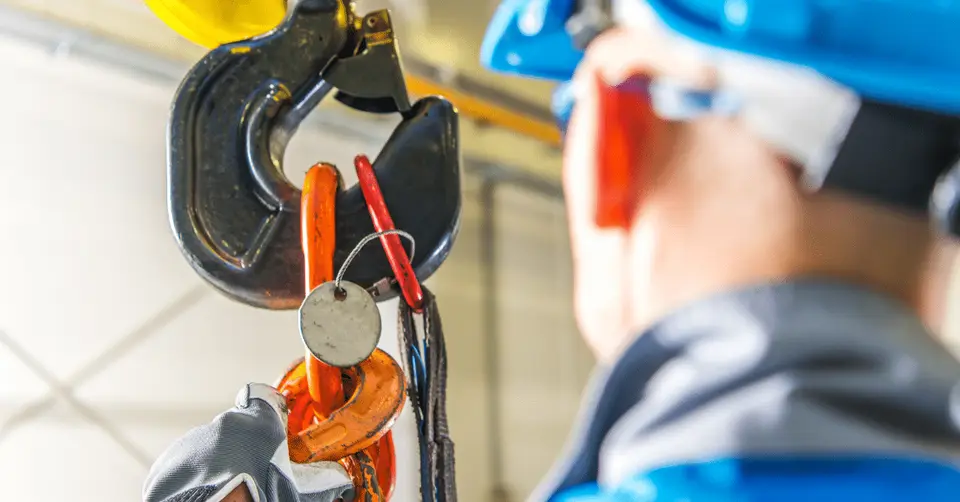
Subpart CC requires qualified riggers for rigging during assembly and disassembly and for hooking, unhooking and guiding loads in certain situations. A qualified rigger is a rigger who meets OSHA's definition of a qualified person for the rigging task: someone with a recognized certificate or extensive knowledge, training and experience who can solve rigging problems.
OSHA does not require a specific rigger certification, but employers must be able to show the rigger is qualified. Third-party certification, such as NCCCO Rigger Level I or II, is one strong way to document it. Our rigger qualification and certification program supports both employer qualification and NCCCO exams.
Competent and Qualified Persons
Inspections and certain site decisions depend on people with the right knowledge:
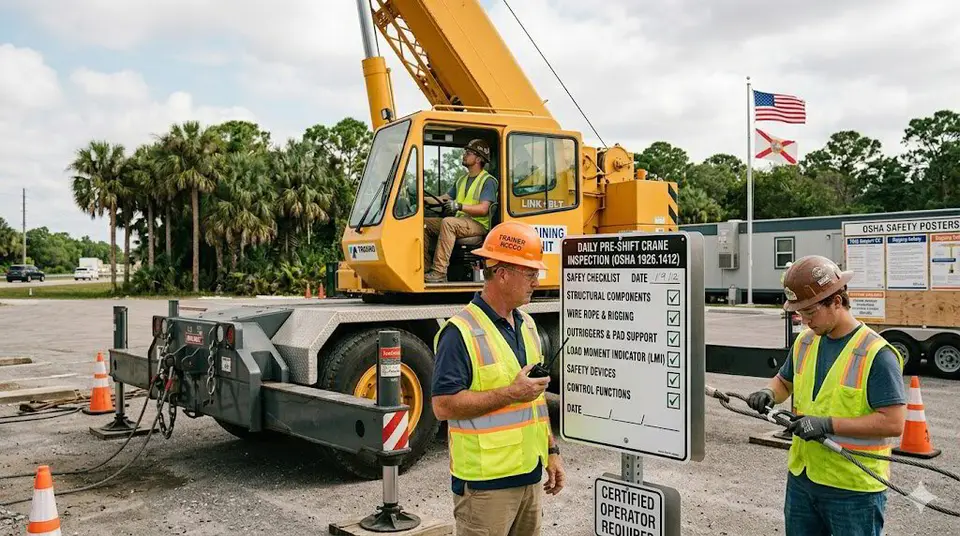
- Competent persons perform shift and monthly inspections and must be able to identify existing and predictable hazards, with authority to correct them
- Qualified persons perform annual inspections, post-assembly and post-repair inspections, and certain engineering-related determinations
Training under 1926.1430 extends to these roles so they can carry out their duties. These are often supervisors, lead operators or maintenance staff. The Managing Crane Safety Class helps supervisors understand their responsibilities for inspections, planning and compliance.
Workers Around the Crane
Ground crews and other trades need training too, even if they never touch the controls. Under 1926.1430, employers must train affected workers on:
- Power line hazards, including the danger of electrocution when equipment contacts a line, the need to stay clear of the equipment and load, and the procedures to follow if contact occurs
- Crush and pinch points, including the swing radius of the rotating superstructure
- Tag-out and start-up procedures, for operators and anyone authorized to start or energize equipment that has been tagged out
This is often handled through site orientation and toolbox talks, but it must happen and should be documented.
Training Evaluation and Retraining
OSHA does not consider training complete just because a class was held. Employers must evaluate each employee to confirm understanding of the information provided in training, and retrain when an employee's conduct or performance shows the need. For operators, retraining is required when the employer's evaluation or the operator's performance indicates it.
In practice, that means watching people work after training, correcting mistakes early and keeping records of both.
Role-by-Role Summary
| Role | Key OSHA requirement | Common way to meet it |
|---|---|---|
| Operator | Certification by type, employer evaluation, training | NCCCO certification plus documented evaluation |
| Operator-in-training | Supervision and task limits | Structured training program |
| Signal person | Qualification under 1926.1428 | NCCCO Signalperson or employer qualified evaluator |
| Rigger | Qualified for the rigging task | NCCCO Rigger certification or documented qualification |
| Competent/qualified person | Knowledge for inspections and decisions | Experience plus targeted training |
| Ground crew | Power line, crush/pinch and tag-out training | Site orientation and toolbox talks |
Get Your Crew Trained
The Crane School has trained operators, riggers and signal persons for more than 21 years and can deliver programs at your site or at our facility in Seffner, Florida. For a look at how these requirements developed, read crane regulation updates you need to know. Contact us to build a training plan for your team.
FAQ
Do ground workers need crane training under OSHA?
Yes, for the hazards they face. Employers must train affected workers on power line hazards, crush and pinch points around the equipment and tag-out procedures.
Is a qualified rigger the same as a certified rigger?
Not necessarily. OSHA requires a qualified rigger for certain work but does not mandate certification. Certification, such as NCCCO Rigger Level I or II, is one way to document qualification.
How often must crane crews be retrained?
OSHA requires retraining when an employer's evaluation or a worker's performance shows a need, rather than on a fixed schedule. Operator certifications themselves must be renewed every five years for NCCCO.