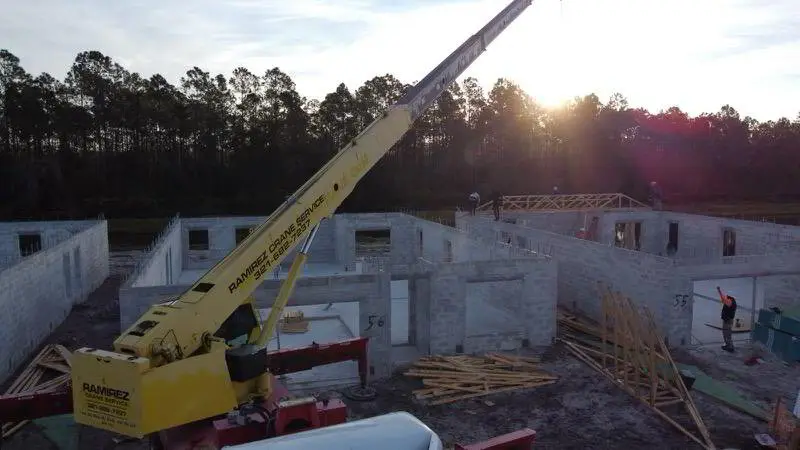

Crane lifting a rooftop HVAC unit onto a research building in Boulder, Colorado with the Flatirons behind
Boulder County, CO

Crane Operator Certification Prep in Boulder, Colorado

NCCCO exam preparation for crews lifting on Boulder's university, research and commercial projects at the foot of the Flatirons.

Campus, Lab and Tech Projects

Boulder's construction is shaped by the University of Colorado Boulder, federal research laboratories, and a cluster of aerospace and technology companies. That means lab buildings packed with mechanical equipment, rooftop units that have to be lifted onto occupied structures, and tight sites bordered by neighborhoods, open space and bike paths.

The Crane School supports crane operator certification in Boulder by bringing instructors and NCCCO accredited practical examiners to employer facilities, or by hosting operators at our training center in Seffner, Florida. There is no Boulder office.

Mountain projects west of town add another layer: narrow canyon roads, limited setup space and rapidly changing weather at higher elevations. Contractors who work both in town and in the foothills benefit from operators who are comfortable assessing ground, slope and wind on unfamiliar sites.

When the Wind Comes Off the Foothills

Boulder is known for powerful downslope winds that rush off the Front Range, mostly in the colder months. Gusts can arrive suddenly and far exceed what the forecast suggested for the wider metro. For crane work, that means wind monitoring at the boom tip, firm stop-work criteria and extra caution with large, light loads like roof panels and HVAC units.

Snow, freeze-thaw cycles and summer hail round out the weather picture. Operators who prepare well learn to treat the manufacturer's wind charts and the lift plan as hard limits, not suggestions.

Work around laboratories adds its own considerations. Sensitive instruments, vibration limits, fume hoods and occupied spaces below the roof all influence when and how a pick happens. Crews may be asked to lift on weekends or early mornings, coordinate with building managers and keep swing paths clear of air intakes. A disciplined, well-trained lift team handles those constraints without improvising.

Programs for Boulder Operators and Facilities Teams

  • Mobile crane operators setting rooftop and lab equipment can prepare for NCCCO TSS, TLL or LAT through mobile crane certification prep.
  • Signalpersons who guide picks over occupied buildings, where the operator rarely sees the landing zone, can certify through our signalperson program.
  • Telehandler operators on campus and commercial sites can earn NCCCO THO certification through the telehandler operator program.
  • Facilities managers who oversee contractors' lifts can take the Managing Crane Safety class.

Universities and research facilities often keep in-house maintenance crews with boom trucks or knuckle booms. Those operators can prepare for articulating crane certifications as well.

Training Logistics from Boulder

On-site

We teach at your facility and can schedule practical exams on your equipment if you have a test area that meets NCCCO requirements. Campus and lab sites usually require advance coordination for access and safety orientation, so give us a little extra lead time. A parking lot or equipment yard on the edge of campus often works better for the practical course than a crowded building site.

Open enrollment

Denver International is under an hour from Boulder in typical traffic. From there, fly to Tampa International and drive about twenty minutes east to Seffner. Written exams are given monthly at our headquarters. Our article on telehandler certification is helpful if that credential is on your list.

Colorado Certification Rules

Boulder operators follow federal OSHA requirements; Colorado has no separate state crane license. Construction operators must be certified under 29 CFR 1926.1427, and universities, labs and owners may add their own rules. More is on our Colorado statewide overview.

Frequently Asked Questions

Can university facilities staff in Boulder be trained on-site?

Yes. On-site training for organizations and groups is a core service. We can plan classroom sessions and practical exams around your campus access rules.

Why do Boulder lifts need extra wind planning?

Strong downslope winds can gust suddenly off the foothills. Operators should monitor wind continuously and stop work when conditions exceed the lift plan or manufacturer's limits.

Is telehandler certification separate from crane certification?

Yes. NCCCO's THO certification covers telehandlers specifically, and it has its own written and practical exams.

The Crane School

Training Programs & Services

All programs are delivered in compliance with current OSHA regulations.

Mobile Crane Operator Certification Prep Program

For experienced operators ready to certify or recertify. Includes NCCCO TSS, TLL and LAT written and practical exams.

Learn more about Mobile Crane Certification Prep

Initial Mobile Crane Operator Training Program

For people with little or no crane experience. 3-week (TSS/TLL) and 5-week (adds LAT) programs with NCCCO exams.

Learn more about Initial Mobile Crane Training (3 & 5 Week)

Articulating Crane Operator Certification Prep Program

For knuckle-boom operators. Prepares you for the NCCCO ABC, ABL and ABW written and practical exams.

Learn more about Articulating Crane Certification Prep

Rigger Qualification / Certification Program

For personnel who rig loads to cranes — supports your rigger qualification and NCCCO Rigger Level I/II exams.

Learn more about Rigger Level 1 & 2

Signalperson Qualification / Certification Program

Standard hand and voice signals for directing cranes, plus preparation for the NCCCO Signalperson exams.

Learn more about Signalperson

Managing Crane Safety Class

For managers and supervisors: OSHA compliance, lift planning, inspections, certification and liability.

Learn more about Managing Crane Safety

Telehandler Operator Program

Certification or recertification for telehandler operators. Includes the NCCCO THO written and practical exams.

Learn more about Telehandler Operator

Crane Inspection Services

Annual, monthly, post-assembly and post-incident inspections plus load testing by NCCCO-certified inspectors.

Learn more about Crane Inspections

Related Reading

Training Program

Telehandler Operator Certification Program

Telehandler certification prep for the NCCCO THO written and practical exams, fixed or rotating. Certify or recertify. Join the list for upcoming dates.

Crane Operator Practice Test

Ten quick questions on crane safety rules and NCCCO basics. Pick one answer per question — your score shows on the next page.

1. Which OSHA standard covers cranes and derricks used in construction?
2. How long is an NCCCO crane operator certification valid before recertification?
3. What does NCCCO stand for?
4. Under OSHA's current construction crane rule, operator certification must be obtained by:
5. Under OSHA Table A (1926.1408), what is the minimum clearance from power lines rated up to 50 kV?
6. When is a signal person required?
7. Whose emergency stop signal must a crane operator obey?
8. What does an anti-two-block device prevent?
9. Which document gives a crane's rated capacity for a given boom length and radius?
10. Which NCCCO designation covers telescopic boom cranes with a swing cab?