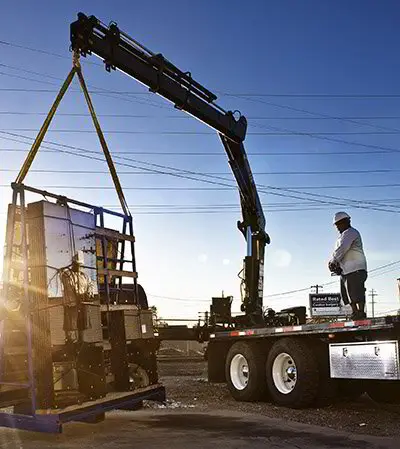

Lattice boom crane working on the Delaware River waterfront in Camden, New Jersey
Delaware River waterfront

Camden, New Jersey Crane Certification Training

Plenty of Camden operators spend half the year on Philadelphia jobs. Get exam-ready on your own Delaware River site, or come train with us in Seffner, Florida.

Camden crane certification training on the waterfront

Camden faces Philadelphia across the Delaware River. Port terminals, waterfront redevelopment, bridge work, industrial sites and institutional campuses keep cranes and lifting crews busy throughout the city and Camden County.

The Crane School supports Camden NJ crane certification training without a local office. Either we set up at your terminal, plant or jobsite, or your crew heads south to sit in a public class at the Seffner, Florida yard. NCCCO, the independent certifying body, issues the credential once candidates pass.

Two states, one river

Crews based in Camden regularly cross the bridges for Pennsylvania jobs, which makes licensing a practical question.

  • On the Jersey side, state-level crane operator requirements apply in addition to OSHA. Ask New Jersey's state licensing agency what it currently expects, and read NCCCO's state notes, before taking a Jersey-side job.
  • Across the bridges, Pennsylvania has its own state-level rules, and Philadelphia layers a city crane license on top. Confirm with the state and city before taking work across the river.

Think of an NCCCO card as the base layer; each state or city may stack its own paperwork above it.

Port, industrial and heavy lifting

Waterfront and industrial projects often involve heavier picks, lattice boom crawlers and complex rigging. Operators who already know their way around a crawler or hydraulic can go after TSS, TLL and LAT in our monthly mobile crane prep.

Rigging decisions carry real weight on these jobs, especially when equipment arrives in odd shapes or needs to be tandem-lifted. NCCCO Rigger Level I and II are the goal of our rigging course. For two-crane picks, our article on dual crane operation training explains the planning involved.

Maintenance staff at terminals and plants also tend to drive knuckle-boom trucks or telehandlers. For them, our articulating and telehandler courses are the right match.

On-site training versus Seffner

On-site

Bring operators, riggers and signalpersons into one room at your plant and train them as a unit. Our NCCCO accredited examiners then run practicals on your cranes, so nobody strays far from the job.

Seffner

A single operator can catch the monthly session in Seffner, outside Tampa. That mobile crane session goes Friday to Monday, and the yard hosts written CCO testing monthly as well. Newcomers can sign up for three or five weeks of initial operator training, four days a week.

With jobs spread across two states, Camden contractors tend to have the best luck booking us in a lull between big projects. Give us a few candidate weeks and we will work out the logistics, including the space needed for practical test courses.

Planning your next step

Start by listing which machines each operator runs and which jurisdictions your crews will work in this year. That shapes both the programs you need and the licensing steps to plan around. A crane operator who works only in Camden County has a simpler path than one splitting time between New Jersey and Philadelphia.

Next, look at timing. River jobs frequently run on seasonal windows, and a new card usually takes three to five weeks to show up after you pass. Leave room for that wait so nobody is stuck on the sidelines when the project starts. Once you have a roster, share it with our office and we'll propose some weeks. Statewide program information lives on our New Jersey overview.
Frequently Asked Questions

Do I need a Philadelphia license if I'm certified in New Jersey?

Quite possibly; Philadelphia is known for running a crane license of its own. Get the city's current answer before you set up across the river.

Could practical testing happen right at our port terminal?

Yes, if the crane and the space for the test course pass NCCCO's checks. We review the site with you during planning.

Which program fits terminal maintenance crews?

Knuckle-boom drivers belong in the articulating course, and anyone on a telehandler belongs in that dedicated class. Hydraulic and lattice machines fall under mobile crane prep.

The Crane School

Training Programs & Services

All programs are delivered in compliance with current OSHA regulations.

Mobile Crane Operator Certification Prep Program

For experienced operators ready to certify or recertify. Includes NCCCO TSS, TLL and LAT written and practical exams.

Learn more about Mobile Crane Certification Prep

Initial Mobile Crane Operator Training Program

For people with little or no crane experience. 3-week (TSS/TLL) and 5-week (adds LAT) programs with NCCCO exams.

Learn more about Initial Mobile Crane Training (3 & 5 Week)

Articulating Crane Operator Certification Prep Program

For knuckle-boom operators. Prepares you for the NCCCO ABC, ABL and ABW written and practical exams.

Learn more about Articulating Crane Certification Prep

Rigger Qualification / Certification Program

For personnel who rig loads to cranes — supports your rigger qualification and NCCCO Rigger Level I/II exams.

Learn more about Rigger Level 1 & 2

Signalperson Qualification / Certification Program

Standard hand and voice signals for directing cranes, plus preparation for the NCCCO Signalperson exams.

Learn more about Signalperson

Managing Crane Safety Class

For managers and supervisors: OSHA compliance, lift planning, inspections, certification and liability.

Learn more about Managing Crane Safety

Telehandler Operator Program

Certification or recertification for telehandler operators. Includes the NCCCO THO written and practical exams.

Learn more about Telehandler Operator

Crane Inspection Services

Annual, monthly, post-assembly and post-incident inspections plus load testing by NCCCO-certified inspectors.

Learn more about Crane Inspections

Related Reading

Crane Operator Practice Test

Ten quick questions on crane safety rules and NCCCO basics. Pick one answer per question — your score shows on the next page.

1. Which OSHA standard covers cranes and derricks used in construction?
2. How long is an NCCCO crane operator certification valid before recertification?
3. What does NCCCO stand for?
4. Under OSHA's current construction crane rule, operator certification must be obtained by:
5. Under OSHA Table A (1926.1408), what is the minimum clearance from power lines rated up to 50 kV?
6. When is a signal person required?
7. Whose emergency stop signal must a crane operator obey?
8. What does an anti-two-block device prevent?
9. Which document gives a crane's rated capacity for a given boom length and radius?
10. Which NCCCO designation covers telescopic boom cranes with a swing cab?