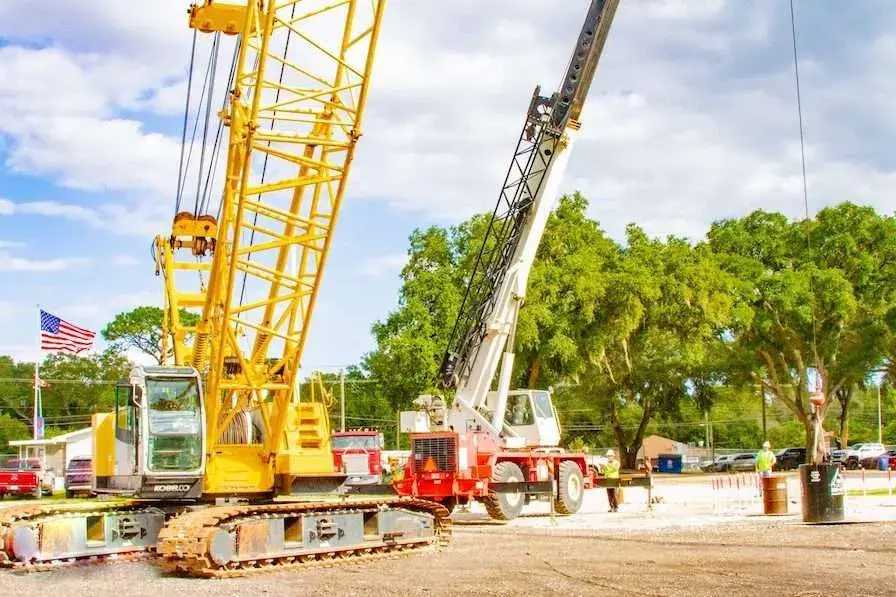

Hydraulic crane lifting steel at a logistics terminal near Port Newark, New Jersey
Newark, NJ

Crane Operator Training for Newark, New Jersey Crews

Port, airport and urban projects keep Newark cranes busy. Your crew can get ready for NCCCO testing right at your Essex County yard, or make the trip south to Seffner, Florida.

Newark's mix of port, airport and city work

As New Jersey's biggest city, Newark ties together Port Newark, Newark Liberty International Airport and a dense web of highway and rail routes. Terminal work, warehouse construction, transit and highway projects, and downtown building all depend on skilled crane crews.

We handle crane operator training in Newark, NJ in one of two ways: our instructors come to your jobsite, or your people come to our Seffner, Florida yard. There's no Garden State branch. What we do is coach candidates through the National Commission for the Certification of Crane Operators testing process, while the card itself comes from NCCCO.

Licensing in New Jersey and across the Hudson

New Jersey layers its own crane operator requirements over the federal OSHA rule, so factor that in early. Before a Newark pick, look up what the responsible New Jersey agency currently asks for and compare it against NCCCO's state-by-state licensing notes.

Plenty of North Jersey hands cross the river for jobs in Manhattan, Brooklyn or Queens. For many crane operations in the five boroughs, the NYC Department of Buildings expects a city hoisting machine operator license, and an NCCCO card by itself may fall short. Get the DOB's current answer for your specific work before taking a city job.

Keeping state and city steps separate from certification makes planning simpler: certify first, then complete each jurisdiction's process.

Crane operator training programs for Newark crews

Port and logistics work leans on a mix of equipment.

  • Hydraulic and lattice machines on steel and terminal jobs: our prep for the TSS, TLL and LAT exams fits operators who already have seat time.
  • Telehandlers moving material at distribution centers and buildings: NCCCO THO is the goal of our telehandler class.
  • The people on the ground: whoever hooks loads or gives signals can earn documented qualification through our rigger and signalperson courses.

For those running the job rather than the controls, Managing Crane Safety walks through who is responsible for what, lift planning, inspections and compliance.

Working in a crowded corridor

Newark jobs often happen next to active highways, rail lines, airport operations or busy terminals. Restricted work windows, overhead clearances and power lines are common constraints.

That's why we spend real class time on OSHA 1926.1408 power line clearances, how a lift gets planned, and how the crew talks during it. Airport-adjacent work can also involve height restrictions and coordination with airport authorities, and terminal jobs may require site-specific security procedures. Those details belong in the lift plan from the beginning, not as last-minute changes.

Crews squeezed between traffic and tracks may want to read our rundown of OSHA rigging and signaling rules before class.

Weather adds to the challenge. Gusty winds off Newark Bay and winter storms can shut down picks, so training dates in spring or fall often give crews the most predictable conditions for practical sessions.

How to schedule

Employers with several candidates usually host on-site training. We teach on the machines your crew already runs, and an NCCCO accredited examiner gives the practicals there too. A single operator is better off flying down for the monthly open-enrollment weekend or the longer beginner course. Tampa International is a common nonstop from Newark Liberty, and students get a special rate at the Holiday Inn Express Tampa Fairgrounds.

For more than 21 years we've readied people for crane certification exams. Among our teaching staff you'll find NCCCO certified operators, inspectors, riggers and signalpersons.

Upcoming sessions are posted on the course calendar; statewide details live on the New Jersey training overview.
Frequently Asked Questions

Will my NCCCO card let me run a crane across the river in NYC?

Not necessarily. Many NYC crane operations call for a hoisting machine operator license issued by the city's Department of Buildings. Ask the DOB what applies to your work first.

Could the practicals take place at our own Newark site?

They can, provided your crane and the test course satisfy NCCCO's setup rules. Because our staff includes accredited examiners, we can bring the practical to you.

What do Newark students need to pack?

Boots with protective toes, a hard hat, gloves and work clothes, plus a government-issued photo ID and a driver's license in good standing. We supply training materials.

The Crane School

Training Programs & Services

All programs are delivered in compliance with current OSHA regulations.

Mobile Crane Operator Certification Prep Program

For experienced operators ready to certify or recertify. Includes NCCCO TSS, TLL and LAT written and practical exams.

Learn more about Mobile Crane Certification Prep

Initial Mobile Crane Operator Training Program

For people with little or no crane experience. 3-week (TSS/TLL) and 5-week (adds LAT) programs with NCCCO exams.

Learn more about Initial Mobile Crane Training (3 & 5 Week)

Articulating Crane Operator Certification Prep Program

For knuckle-boom operators. Prepares you for the NCCCO ABC, ABL and ABW written and practical exams.

Learn more about Articulating Crane Certification Prep

Rigger Qualification / Certification Program

For personnel who rig loads to cranes — supports your rigger qualification and NCCCO Rigger Level I/II exams.

Learn more about Rigger Level 1 & 2

Signalperson Qualification / Certification Program

Standard hand and voice signals for directing cranes, plus preparation for the NCCCO Signalperson exams.

Learn more about Signalperson

Managing Crane Safety Class

For managers and supervisors: OSHA compliance, lift planning, inspections, certification and liability.

Learn more about Managing Crane Safety

Telehandler Operator Program

Certification or recertification for telehandler operators. Includes the NCCCO THO written and practical exams.

Learn more about Telehandler Operator

Crane Inspection Services

Annual, monthly, post-assembly and post-incident inspections plus load testing by NCCCO-certified inspectors.

Learn more about Crane Inspections

Related Reading

Training Program

Telehandler Operator Certification Program

Telehandler certification prep for the NCCCO THO written and practical exams, fixed or rotating. Certify or recertify. Join the list for upcoming dates.

Crane Operator Practice Test

Ten quick questions on crane safety rules and NCCCO basics. Pick one answer per question — your score shows on the next page.

1. Which OSHA standard covers cranes and derricks used in construction?
2. How long is an NCCCO crane operator certification valid before recertification?
3. What does NCCCO stand for?
4. Under OSHA's current construction crane rule, operator certification must be obtained by:
5. Under OSHA Table A (1926.1408), what is the minimum clearance from power lines rated up to 50 kV?
6. When is a signal person required?
7. Whose emergency stop signal must a crane operator obey?
8. What does an anti-two-block device prevent?
9. Which document gives a crane's rated capacity for a given boom length and radius?
10. Which NCCCO designation covers telescopic boom cranes with a swing cab?