The Silent Conversation: Crane Rigging and Hand Signals Explained
The Lift Starts on the Ground
Watch a crane from across the street and it looks like a one-person job. The operator is in the cab, the load goes up and over, and that's that. What you don't see is the conversation happening below.
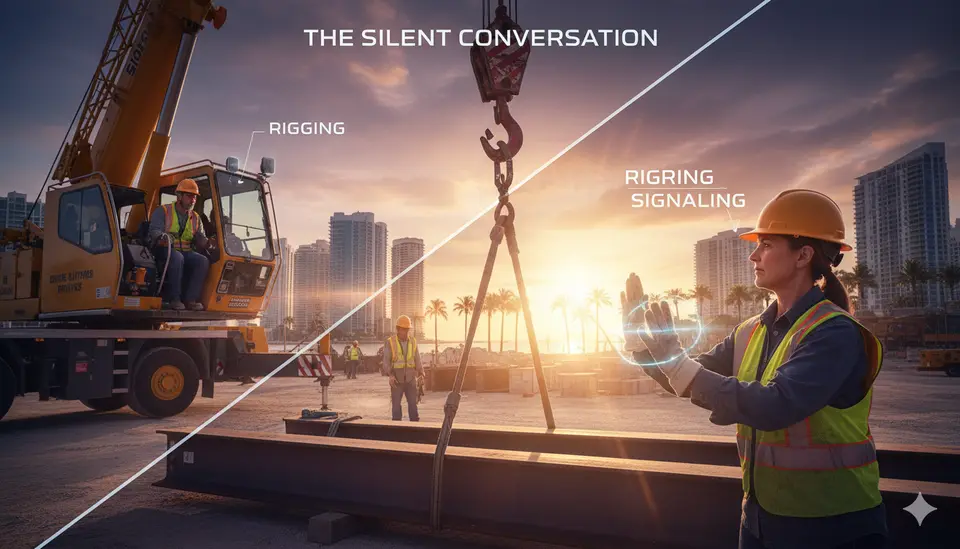
A rigger has already chosen the gear, checked it and balanced the load. A signalperson is standing where they can see what the operator can't, directing every move. This article walks through both halves of that work, crane rigging and hand signals, for anyone heading into a crane career or trying to understand the people they will work alongside.
The Rigger: Planning the Pick
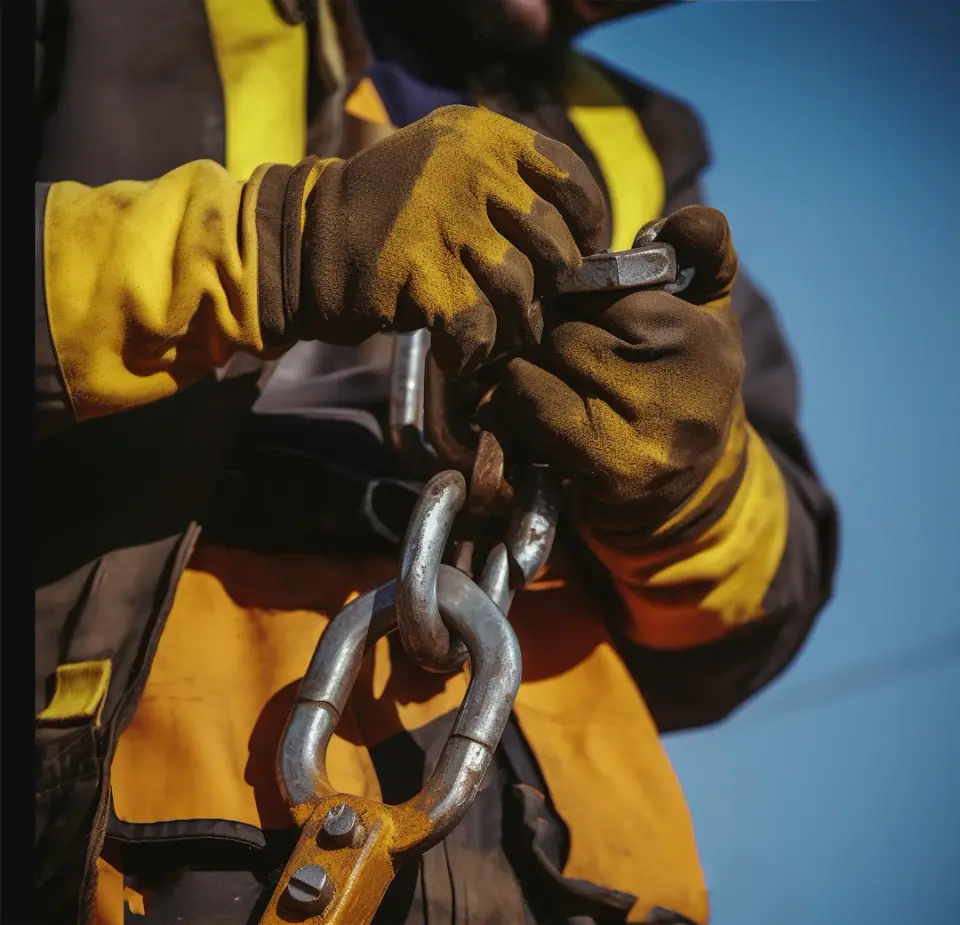
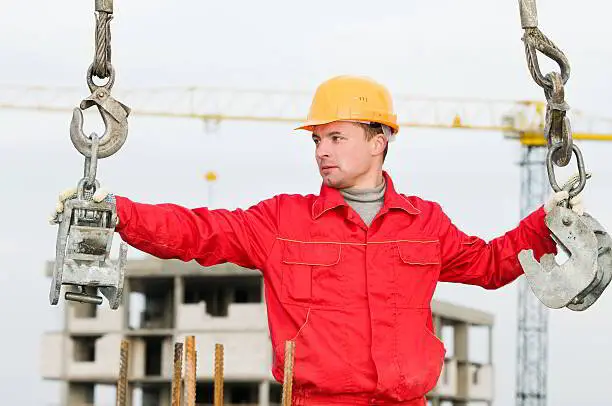
A rigger's job is to make sure the load stays attached, stays balanced and doesn't damage the gear or itself. Before anything leaves the ground, a rigger:
- Inspects the gear. Slings, shackles, hooks and hardware get checked before each use for cuts, kinks, stretched links, cracks or heat damage.
- Knows the weight. Either from documentation or, for an advanced rigger, by estimating it from dimensions and material.
- Finds the center of gravity. The hook must end up directly above it, or the load tilts as soon as it lifts.
- Selects the right equipment. Sling type, length, hitch and hardware all have to suit the load's weight, shape and surface.
- Rigs it securely. Connections must hold without crushing or marking the load.
Inside the Rigger's Toolbox
Slings
- Wire rope slings are strong and resist abrasion and cutting. They are a common all-purpose choice but are heavy and can kink if mishandled.
- Alloy chain slings hold up to heat and rough conditions and can be adjusted for length. They are heavy and need careful inspection for stretched or gouged links.
- Synthetic web and round slings, made of nylon or polyester, are light and flexible and won't mar finished surfaces. They cut easily on sharp edges and are vulnerable to heat and some chemicals, so edge protection matters.
Hardware
- Shackles connect slings to the load or the hook. Pin type and rated capacity must suit the job.
- Hooks need working safety latches unless a qualified person determines otherwise for a specific application.
- Eyebolts and hoist rings thread into the load to create a lifting point. They must be fully seated and rated for the direction of pull.
Below-the-hook devices
Spreader bars and lifting beams handle long, flexible or awkward loads by spreading the attachment points, reducing crushing forces and improving stability.
The Physics You Can't Skip
Center of gravity
If the hook is not over the center of gravity, the load will rotate or tilt as it comes off the ground until the center of gravity settles under the hook. That shift can shock-load the rigging or let a load slip from a choker. Lifting a few inches first and checking the balance is standard practice.
Sling angle
This is the concept that catches people out. When a sling leg is angled, the tension in it is higher than its share of the load. Measured from horizontal:
- At 60 degrees, each leg carries about 1.15 times its share.
- At 45 degrees, about 1.41 times.
- At 30 degrees, about 2 times.
So two legs at 30 degrees lifting a 10,000-pound load each see roughly 10,000 pounds of tension, not 5,000. Riggers learn to keep angles steep and to size slings for the real tension. These calculations are a big part of rigging certification exams.
The Signalperson: The Operator's Eyes
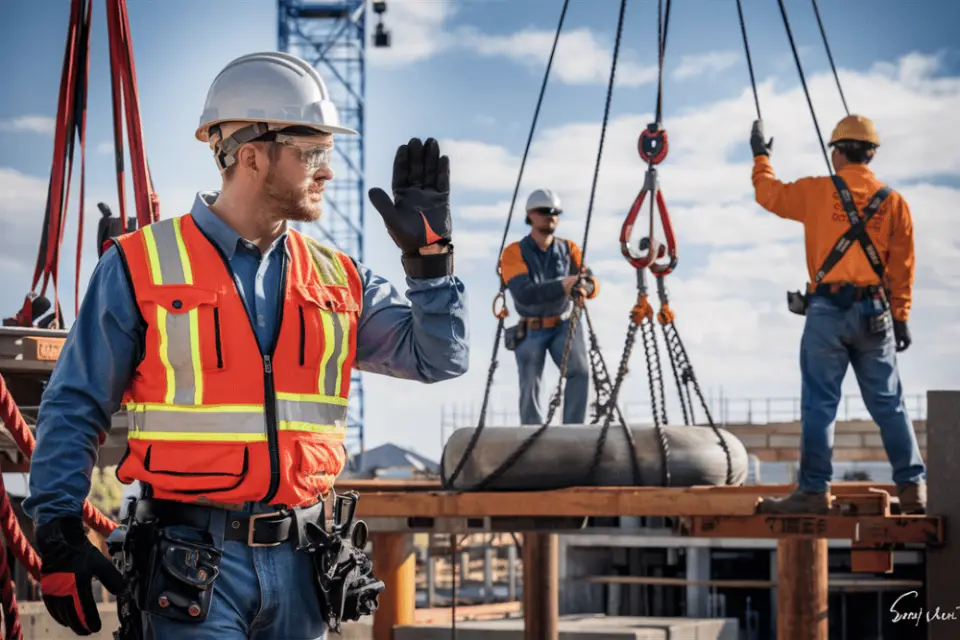
When the operator can't see the load or its landing area, a signalperson takes over communication. OSHA requires one when the point of operation isn't in full view, when the view in the direction of travel is blocked, or when site conditions call for it.
Standard hand signals
OSHA's standard method, shown in Appendix A to Subpart CC, gives every crew the same language. A few core signals:
- Hoist: forearm vertical, forefinger pointing up, hand moving in a small horizontal circle.
- Lower: arm extended downward, forefinger pointing down, hand moving in a small horizontal circle.
- Swing: arm extended, pointing with a finger in the direction to swing the boom.
- Stop: arm extended, palm down, moving the arm back and forth horizontally.
- Emergency stop: both arms extended, palms down, moving both arms back and forth horizontally.
Signals must be crisp and deliberate. A sloppy signal is an unclear signal.
Position and the fall zone
A good signalperson stands where they can see the load and its path, and where the operator can see them. They also keep other workers out of the fall zone, the area where the load could land if it dropped.
Radio Discipline
On large sites or blind lifts, signals move to radio. That brings its own rules:
- Agree on voice signals with the operator before the lift starts.
- Use a dedicated channel so other traffic doesn't cut in.
- Give commands in a consistent order: crane identification, function, direction.
- Keep talking during continuous movements so the operator knows you are still there. Silence should mean stop.
- No slang, no side conversations.
Why Operators Should Learn Both
Operators who understand rigging spot a questionable hitch before they hoist. Operators who understand signaling know exactly what the person on the ground is asking for. That is why many students add rigging and signalperson training to their operator program.
To go deeper, see the Rigger Qualification and Certification Program and the Signalperson Qualification and Certification Program. For how the two classes compare in length and cost, read rigger and signalperson training, and for the rules behind it all, our summary of OSHA rigging and signaling requirements.
Learn the Ground Side of the Lift
Hands-on practice with real gear and a real crane is the fastest way to learn this language. Contact The Crane School to find a rigging or signaling class date.
FAQ
Why does sling angle matter so much?
The lower the angle from horizontal, the more tension each sling leg carries. At 30 degrees, each leg sees about twice its share of the load, which can overload gear sized only for the load weight.
Which sling type is best?
It depends on the load. Wire rope resists abrasion, chain handles heat and rough use, and synthetic slings protect finished surfaces but need edge protection.
Who can give an emergency stop signal?
Anyone. The operator must obey an emergency stop signal regardless of who gives it.