Signalperson Training in Florida: How to Choose the Right Program
Why Your Choice of Signalperson Training in Florida Matters
Florida keeps a lot of cranes busy: high-rise work in the major metros, port and industrial projects, and storm recovery after hurricane season. Every one of those lifts can require a signalperson when the operator cannot see the load or the landing area.
Picking signalperson training in Florida is not only about finding the closest class. The right program gives you a credential your employer and the site will accept, plus the confidence to actually run a lift from the ground. This guide walks through how to compare programs fairly.
What Florida Rules Actually Require
Florida does not have its own state crane licensing program, so private-sector construction work in the state follows federal OSHA. The relevant rule is 29 CFR 1926.1428, which says a signal person must be qualified before giving signals.
OSHA allows two routes to that qualification:
- Third-party qualified evaluator, such as an accredited certifying body like NCCCO. This documentation is portable from employer to employer.
- Employer's qualified evaluator, a person the employer designates as competent to assess signal persons. This qualification is not portable to a new employer.
Either way, the signal person must know the signals, be competent applying them, understand basic crane operation and limitations, and pass an oral or written test plus a practical test. Many general contractors go beyond the minimum and ask for NCCCO Signalperson certification by name, so check your project's requirements.
Two Program Types You Will See
Most Florida providers offer some version of these two options.
Signalperson qualification
A shorter class aimed at meeting OSHA's qualification requirement through an employer's evaluation process. The Crane School's Signal Person Qualification class runs two days and is listed at $425. It does not include the NCCCO practical exam.
NCCCO Signalperson certification
A third-party certification that requires passing both a written exam and a practical exam. The Crane School's Signal Person Only Certification with Practical is a three-day class: two days of instruction, then the practical exam on day three. It is listed at $1,375.
Not sure which one fits? Our breakdown of signalperson qualification versus certification goes deeper.
A Side-by-Side Checklist for Comparing Providers
Rather than relying on rankings, score each program you are considering on the same points.
- Exam access: Can you take the written exam locally and on a predictable schedule? The Crane School offers CCO written exams every month at its Seffner headquarters.
- Practical examiner on staff: Programs with NCCCO accredited practical examiners can schedule practicals without sending you elsewhere.
- Practice time: You should spend real time giving hand and voice signals to a working crane, not just watching slides.
- Instructor background: Ask whether instructors hold NCCCO Signalperson and operator certifications.
- Clear pricing: Get a written price and confirm what is included.
- Scheduling for crews: Employers should ask whether the provider can train on-site.
- Location and logistics: For out-of-town students, check lodging and airport access. Seffner sits just east of Tampa, and Tampa International Airport is the nearest major airport.
Questions That Separate Strong Programs From Weak Ones
When you call a school, these questions get to the point fast:
- What percentage of class time is spent signaling a real crane?
- Do you cover voice signals and radio procedure as well as hand signals?
- Will I learn basic crane dynamics, such as boom deflection and load swing?
- What paperwork will I leave with, and is it a qualification or a certification?
- If I fail the practical, how soon can I retest and what does it cost?
A school that answers clearly and specifically is usually one that runs a well-organized class.
What You Should Be Able to Do After Class
Whichever program you pick, measure it by what you can do afterward. A well-trained signalperson walks onto a Florida site and can:
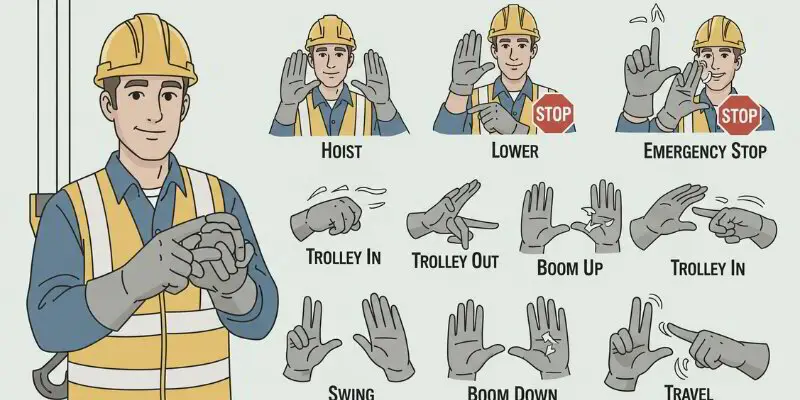
- Give every standard hand signal cleanly, including the emergency stop, with no hesitation.
- Run a lift by voice over a radio, identifying the crane, the function and the direction in each command.
- Choose a position where the operator can see them and they can see the load and its path.
- Keep people out of the fall zone and stop a lift when conditions change, such as a fast-building afternoon thunderstorm or rising wind.
- Recognize when a load is swinging, a tagline is fouled or the boom is deflecting, and signal accordingly.
If a program's syllabus does not clearly lead to those outcomes, keep looking.
A note on weather
Summer storms and hurricane season shape Florida crane work. Good signalperson instruction covers how wind affects a suspended load and when to call a stop. Those judgment calls are part of the job, even if they are not part of every exam.
Who Should Take Which Class
- Laborers and new hires who will occasionally signal: a qualification class is often enough, if the employer accepts it.
- Workers who change employers often: NCCCO certification is portable, which saves you from being re-evaluated at every new job.
- Riggers and operators: adding signalperson certification rounds out your skill set. Many students combine it with rigger certification.
Want the full list of eligibility and documentation rules? Read signalperson certification requirements.
Book a Florida Signalperson Class
The Crane School has been preparing students for crane certifications for more than 21 years. To check class dates in Seffner or set up on-site training for your crew, visit the Signalperson Qualification and Certification Program page or contact us.
FAQ
Does Florida have its own signalperson license?
No. Florida follows federal OSHA rules for construction cranes, and OSHA 1926.1428 sets the signal person qualification requirements. Employers and projects may require NCCCO certification on top of that.
How much does signalperson training cost at The Crane School?
The two-day Signal Person Qualification class is listed at $425, and the three-day Signal Person Only Certification with Practical is listed at $1,375.
Where are signalperson written exams held?
CCO written exams are offered every month at The Crane School's headquarters at 10929 E. US-92 in Seffner, FL.