Signalperson Qualification vs. Certification: How the Program Works

Two Words That Get Used Interchangeably
On job sites, "qualified signal person" and "certified signal person" often get used as if they mean the same thing. They don't, and the difference affects your paperwork, your portability between employers and the class you should sign up for.
This article explains signalperson qualification vs. certification, then walks through how The Crane School's Signalperson Qualification and Certification Program is set up to handle either goal.
What "Qualified" Means Under OSHA
OSHA's crane standard for construction, 29 CFR 1926.1428, requires that anyone giving signals to a crane operator be qualified. The rule says qualification can come from one of two sources.
Option 1: A third-party qualified evaluator
This is an outside entity, such as an accredited certifying body, that tests the signal person. Documentation from a third-party evaluator is portable: it goes with you when you change employers.
Option 2: An employer's qualified evaluator
The employer can designate its own evaluator who has the knowledge and ability to assess signal persons. Qualification from an employer's evaluator is not portable, so a new employer must evaluate you again.
What the evaluation must confirm
Regardless of the route, the signal person must:
- Know and understand the type of signals used on that job (hand, voice or other).
- Be competent applying those signals.
- Have a basic understanding of crane operation and limitations, including boom deflection.
- Know the relevant OSHA signaling requirements.
- Demonstrate all of the above through an oral or written test and a practical test.
The employer must keep documentation available at the site.
What "Certified" Adds
NCCCO Signalperson certification is a nationally recognized credential issued by the National Commission for the Certification of Crane Operators, an independent non-profit. Because NCCCO is a third-party certifying body, its certification satisfies OSHA's third-party route.
To earn it, you pass two exams:
- A written exam covering signaling standards, crane operation basics and the related regulations.
- A practical exam where you direct a crane through a set of tasks using standard hand and voice signals.
The certification is valid for five years. Because it belongs to you rather than to an employer, many contractors prefer it, and some require it.
Quick Comparison
- Who issues it: qualification comes from your employer's evaluator or a third party; certification comes from NCCCO.
- Portability: employer qualification stays with that employer; NCCCO certification goes with you.
- Testing: both require a knowledge test and a practical demonstration; NCCCO uses standardized exams.
- Typical use: qualification fits crews that signal occasionally for one employer; certification fits workers who move between sites or companies.
- Renewal: employers set their own re-evaluation practices; NCCCO certification runs five years before recertification.
How The Crane School's Program Is Structured
The program is built so you can stop at the level you need.
Signal Person Qualification (2 days, $425)
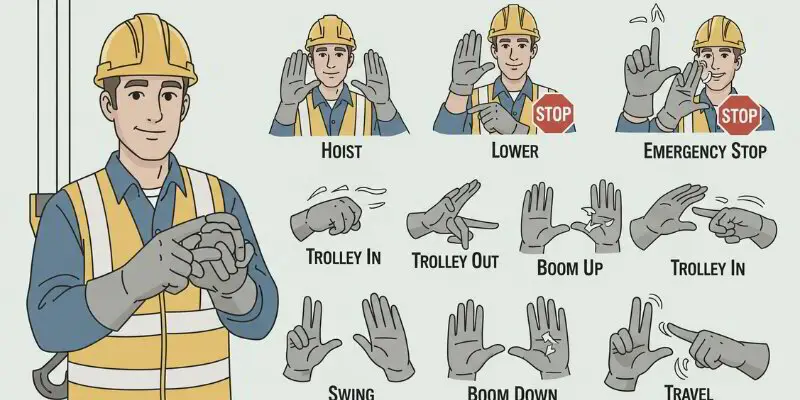
The Signal Person Qualification class covers standard hand and voice signals, crane dynamics and hazard recognition. It supports an employer's qualification process and does not include the NCCCO practical exam.
Signal Person Only Certification with Practical (3 days, $1,375)
The certification class with hands-on practice spends two days in instruction and practice, then sets aside the third day for the NCCCO practical exam. CCO written exams are offered every month at the Seffner headquarters.
Who teaches it
Instructors hold NCCCO certifications as signalpersons, riggers and crane operators, and the staff includes NCCCO accredited practical examiners for signalperson exams. That means practicals can be scheduled at the training center or on-site for employers anywhere in the country.
When a Signal Person Is Needed on Site
It helps to know when you will actually be called on. Under OSHA's crane rule, a signal person is required when:
- The point of operation, meaning the load travel or the area near the landing, is not in full view of the operator.
- The operator's view in the direction of travel is obstructed.
- The operator or the person handling the load decides a signal person is needed because of site-specific safety concerns.
On a congested downtown site or inside an industrial plant, those conditions are common. That is why many crews train several people as signalpersons instead of relying on one.
Employer Responsibilities Either Way
Choosing qualification or certification doesn't end an employer's duties. OSHA expects the employer to make sure signal persons are qualified before they signal, keep the documentation at the site, and act when someone's performance shows they are not meeting the requirements.
If a qualified or certified signal person is observed signaling incorrectly, the employer should stop that person from signaling until they are retrained and re-evaluated. Certification doesn't replace supervision. It gives the employer a reliable starting point.
Good practice also includes a pre-lift talk where the operator, signal person and rigger agree on the signals to be used, the radio channel if voice signals are in play, and who can call a stop. Anyone on the crew can call an emergency stop, and the operator must obey it.
Choosing Your Path
If you work for one employer and signal occasionally, qualification may cover you, provided your employer accepts it. If you move between contractors, travel for work or want a credential that stands on its own, certification is the stronger choice.
For a breakdown of eligibility rules and documentation, read signalperson certification requirements. If you are getting ready for the exams, our signalperson exam tips cover how to prepare.
Get Started
Call (813) 402-2017 or send us a message to pick a class date, ask about on-site training for your crew, or confirm which option your site requires.
FAQ
Is an employer-qualified signal person legal under OSHA?
Yes. OSHA 1926.1428 allows qualification by an employer's qualified evaluator, but that qualification is not portable to another employer.
Does NCCCO Signalperson certification meet OSHA's requirement?
NCCCO is a third-party certifying body, so its signalperson certification is a recognized way to meet OSHA's third-party qualification route.
Can I upgrade from qualification to certification later?
Yes. Taking the qualification class first builds the foundation; you can later take the certification class and the NCCCO written and practical exams.
How long does NCCCO Signalperson certification last?
Five years. You recertify before it expires to keep it active.