The Rigger Certification Process in Florida: A Step-by-Step Timeline
The Process at a Glance
NCCCO uses one set of steps nationwide, but the rigger certification process plays out differently depending on where you live and train. For someone in Florida, it runs in this order:
- Pick your level.
- Check eligibility.
- Choose a training format.
- Prepare and register for exams.
- Take the written exam.
- Take the practical exam.
- Receive results and your card.
- Plan recertification.
We walk through each one below. For more on what each level demands, start with our explainer on what rigger certification requires.
Step 1: Pick Your Level
There are two NCCCO rigger credentials:
- Rigger Level I covers basic, repeated rigging tasks where someone else supplies the weight and center of gravity.
- Rigger Level II is for riggers who work out weight and center of gravity on their own and take on more complex jobs.
Newer riggers generally begin at Level I. If planning lifts and figuring sling loads is already part of your day, Level II could be the better match. Each level comes with a separate written and practical exam.
Step 2: Check Eligibility
Make sure you satisfy NCCCO's basic conditions before paying for a course: you must be 18 or older, follow its substance abuse policy and accept its code of ethics. The current candidate handbook on NCCCO's site lists fees and deadlines.
Find out, too, what your employer or upcoming job expects. Federal OSHA governs in Florida, and it asks for a qualified rigger rather than a certified one, yet many contractors and project owners insist on an NCCCO card regardless. Our post on how rigging certification works in Florida sorts out how those requirements overlap.
Step 3: Choose a Training Format
No particular course is mandatory, but organized prep pays off, above all for the practical. Most Florida candidates pick one of these:
- Open enrollment in Seffner. Our training center sits at 10929 E. US-92, a short drive east of Tampa. The three-day Rigger Only Certification with Practical spends two days on teaching and practice and the third on practical exams; the listed price is $1,375.
- On-site training. An employer can host the program at its own facility anywhere in the U.S.
- Qualification first. When you need to rig right away under your employer's process, the $425 2-Day Rigger Qualification Class is a frequent starting point before certifying later.
Each option sits under our rigger qualification and certification course.
What a Florida Candidate's Week Might Look Like
For someone traveling to Seffner, a typical trip could be laid out like this:
- Days 1 and 2: lessons in the classroom plus hands-on rigging practice alongside instructors.
- Day 3: practicals in front of an NCCCO accredited practical examiner.
- Written exam: scheduled on the school's monthly test date, ideally during the same visit.
Most out-of-town students land at Tampa International. We've negotiated a rate with the Holiday Inn Express Tampa Fairgrounds: phone the hotel at (813) 490-1000, request The Crane School rate and double-check the price when booking. Dates shift, so look at the class schedule before you buy tickets.
Step 4: Prepare and Register
Study every topic on your level's exam outline, including:
- Inspecting slings and hardware, and knowing when to remove them from service.
- Hitch types and how they change capacity.
- Finding load weight and center of gravity.
- Working out sling angles and tension.
- Standard hand signals and the OSHA rules for rigging.
Registration for both exams is something your training provider can help with. Lock in test dates early so they match your class.
Step 5: Take the Written Exam
Expect a proctored multiple-choice test on rigging knowledge. Living in Florida helps here, since The Crane School holds CCO written testing at its Seffner headquarters each month.
Have government-issued photo ID with you. Take your time on every question, and slow down on the math problems, where angles and units trip people up.
Step 6: Take the Practical Exam
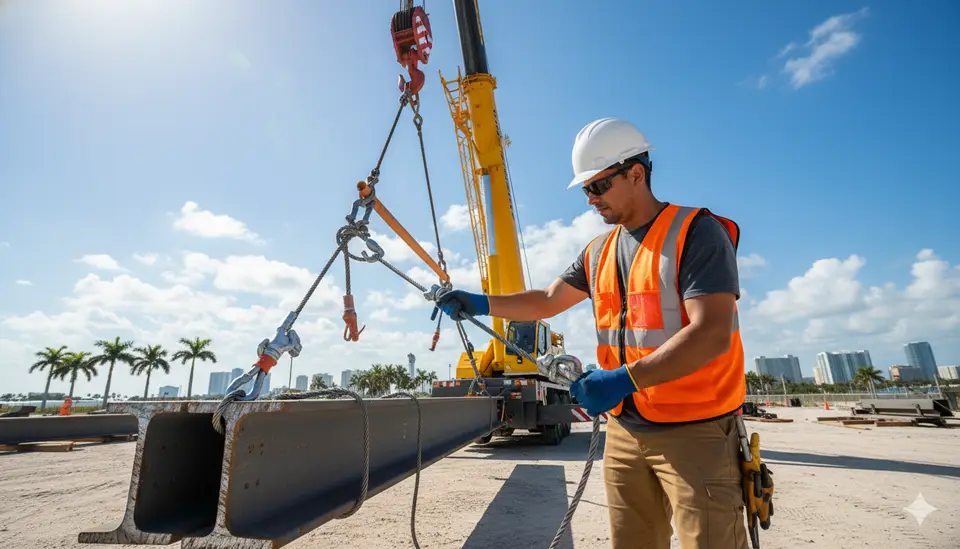
For the practical, you carry out rigging tasks as an NCCCO accredited practical examiner scores you on inspecting, choosing and attaching rigging, along with your overall safety habits.
Since our staff includes accredited rigging examiners, practicals can happen in Seffner or at an on-site location anywhere in the country. Show up in hard-toe boots, a hard hat, gloves and work clothes, with sunglasses for the outdoor portion.
NCCCO typically expects both exams to be passed within a fixed period of each other, so keep the gap between them short.
Step 7: Results and Your Card
Once both exams are passed, your results post to NCCCO's MyCCO app, and the physical card usually follows in three to five weeks. Questions about a score can go to NCCCO Testing Services at 727-449-8525.
Missed one part? You only retake that part, provided you're still inside NCCCO's time limit.
Step 8: Plan Recertification
Certification lasts five years. Set a calendar reminder for the beginning of year five so you can recertify before anything lapses; our two-day rigger recertification class exists for exactly that.
How long does the whole process take?
If you take the three-day certification class in Seffner and line it up with a monthly written test date, you can often finish both exams in one trip, with the card arriving three to five weeks after you pass. Your experience and exam availability will shape the actual timeline.
Start the Process
When you're ready to begin, phone (813) 402-2017 or send us a message to settle on a level, choose class dates and schedule your exams.
FAQ
Where can I take NCCCO rigger exams in Florida?
The Crane School in Seffner, FL holds CCO written testing every month, and its accredited practical examiners can schedule your practical.
How long until I get my rigger card?
Your passing results appear in the MyCCO app first; the card itself usually comes three to five weeks later.
Do I have to take a class before the rigger exams?
NCCCO doesn't mandate any specific course, though most people take formal training, mainly to get ready for the practical.