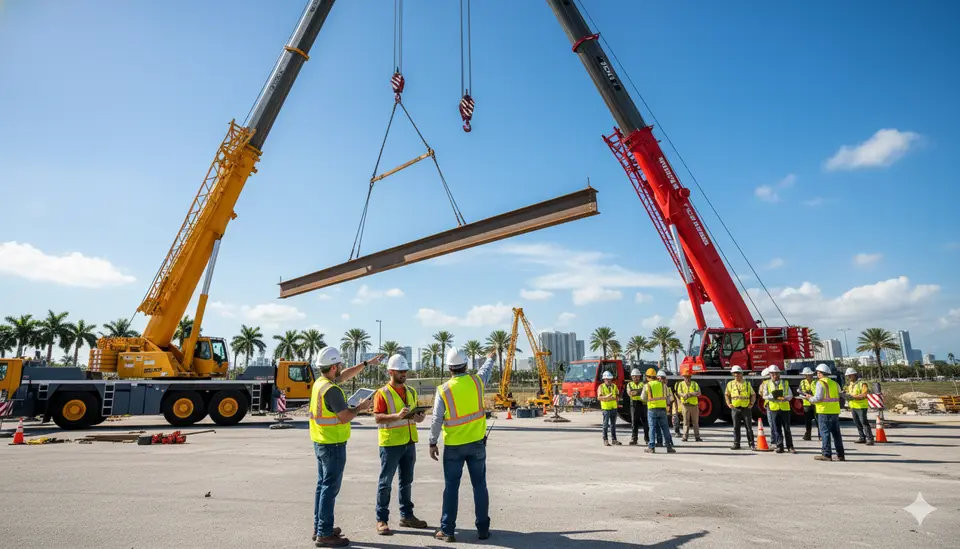

Two cranes setting a bridge girder over a highway
Columbia, Missouri

Crane Operator Training for Columbia and Mid-Missouri

University buildings, hospitals and I-70 corridor work keep cranes busy in Mid-Missouri. Prepare your Columbia crew for NCCCO certification.

A College Town With Steady Construction

Mizzou dominates the skyline here. New academic halls, research labs and medical buildings account for a big slice of the picks in town. Its position on I-70, roughly halfway between Kansas City and St. Louis, also brings highway, bridge and distribution projects. Around the city, agriculture and rural building keep boom trucks and telehandlers moving.

Because of that range, crane operator training in Columbia, MO has to be shaped to the crew in front of us. A campus job and a rural grain facility both need certified people, but they use different machines and face different hazards. The campus job is about people and tight spaces; the rural job is about soft ground, long reaches and doing the work with a smaller crew.

Training That Matches the Work

On campus and around hospitals

Lifts near classrooms, dorms and clinics need tight swing control and reliable communication. Our signalperson course drills the standard hand and voice signals and gets people ready for the NCCCO test. For operators already logging hours, TSS, TLL and LAT prep happens in our once-a-month certification weekend.

On highway and bridge projects

Beam sets and girder picks often involve two cranes and careful rigging. Rigger certification and lift planning matter as much as operating skill.

On rural and agricultural sites

Telehandler and articulating crane programs prepare operators for NCCCO THO and ABC, ABL and ABW exams.

Planning a Multi-Crane Lift

Bridge girders and long precast members are often set with two cranes working together. Each crane carries a share of the load that changes as the piece moves, and a small difference in boom angle or swing can shift weight quickly. Operators, riggers and the lift director all need to understand that before the pick starts.

Tandem picks are planned in advance, with a written lift plan that assigns loads, signals and stop points. For an introduction, read our piece on two-crane picks; superintendents who will own those plans can go deeper in Managing Crane Safety.

On-Site or in Seffner

Mid-Missouri has no Crane School site. Our lone facility is in Seffner, Florida. Contractors can fly our instructors in, and one of our NCCCO-accredited examiners can run the practical on your own iron while we are there.

Solo operators usually fly into Tampa International and register for a public session. Each month brings both a Friday-to-Monday mobile crane prep and a CCO written test date. Get in touch to find dates.

When choosing between the two, consider the season as well as headcount. Sticky summers and icy winters both complicate outdoor testing around Columbia, which makes April-May or September-October the sweet spots. Anyone on a deadline can lean on open enrollment in Florida, which never shuts down for the season; an operator who is rusty can also book Thursday practice hours ahead of the prep weekend.

Missouri Rules

Missouri keeps no state crane license on the commonly cited lists. OSHA's federal rule is the standard, and on construction it calls for type-specific certification. Campus and healthcare owners frequently write extra demands into their specs, so check before you price a job. Broader Missouri details are on our statewide page.

Frequently Asked Questions

Can a contractor certify operators and signalpersons in one on-site visit?

Often, yes. Pairing operator prep with signalperson or rigging sessions lets the cab and the ground crew learn side by side in a single trip.

Is there a crane operator license in Missouri?

No. The state has no separate license on the usual lists, leaving the federal OSHA standard in force. A university or hospital job may still spell out a CCO card in the contract.

What goes in my bag for the first day?

Gloves, a hard hat, hard-toe boots and work clothes, plus a government photo ID and your driver's license. Training materials are provided.

The Crane School

Training Programs & Services

All programs are delivered in compliance with current OSHA regulations.

Mobile Crane Operator Certification Prep Program

For experienced operators ready to certify or recertify. Includes NCCCO TSS, TLL and LAT written and practical exams.

Learn more about Mobile Crane Certification Prep

Initial Mobile Crane Operator Training Program

For people with little or no crane experience. 3-week (TSS/TLL) and 5-week (adds LAT) programs with NCCCO exams.

Learn more about Initial Mobile Crane Training (3 & 5 Week)

Articulating Crane Operator Certification Prep Program

For knuckle-boom operators. Prepares you for the NCCCO ABC, ABL and ABW written and practical exams.

Learn more about Articulating Crane Certification Prep

Rigger Qualification / Certification Program

For personnel who rig loads to cranes — supports your rigger qualification and NCCCO Rigger Level I/II exams.

Learn more about Rigger Level 1 & 2

Signalperson Qualification / Certification Program

Standard hand and voice signals for directing cranes, plus preparation for the NCCCO Signalperson exams.

Learn more about Signalperson

Managing Crane Safety Class

For managers and supervisors: OSHA compliance, lift planning, inspections, certification and liability.

Learn more about Managing Crane Safety

Telehandler Operator Program

Certification or recertification for telehandler operators. Includes the NCCCO THO written and practical exams.

Learn more about Telehandler Operator

Crane Inspection Services

Annual, monthly, post-assembly and post-incident inspections plus load testing by NCCCO-certified inspectors.

Learn more about Crane Inspections

Related Reading

Crane Operator Practice Test

Ten quick questions on crane safety rules and NCCCO basics. Pick one answer per question — your score shows on the next page.

1. Which OSHA standard covers cranes and derricks used in construction?
2. How long is an NCCCO crane operator certification valid before recertification?
3. What does NCCCO stand for?
4. Under OSHA's current construction crane rule, operator certification must be obtained by:
5. Under OSHA Table A (1926.1408), what is the minimum clearance from power lines rated up to 50 kV?
6. When is a signal person required?
7. Whose emergency stop signal must a crane operator obey?
8. What does an anti-two-block device prevent?
9. Which document gives a crane's rated capacity for a given boom length and radius?
10. Which NCCCO designation covers telescopic boom cranes with a swing cab?