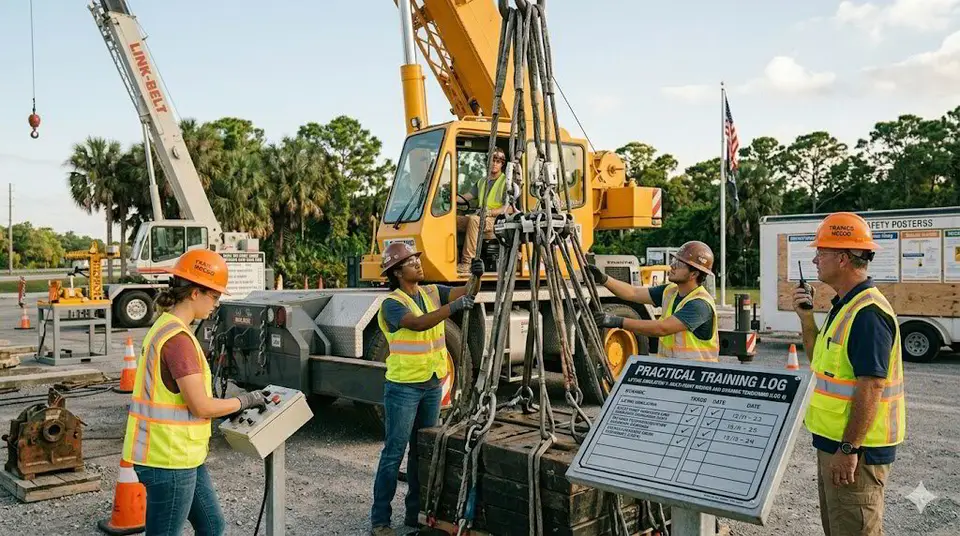

Student operator practicing on a telescopic boom crane during initial training, for Lawton, Oklahoma career-changers
Lawton & Fort Sill area

Crane Operator Certification Training for Lawton, Oklahoma

A practical route into crane operation for Lawton-area veterans and newcomers, plus on-site NCCCO training for local employers.

A Military Town With Heavy Equipment Roots

Lawton grew up alongside Fort Sill, and the Army post still shapes the city's economy and population. Every year, soldiers leave the service and look for civilian careers that use the discipline, teamwork and equipment experience they built in uniform. Crane operation is one of those careers.

If you are weighing crane operator certification in Lawton, OK, this page explains how to get from no civilian crane credential to an NCCCO certification, and how local employers can train their crews.

Starting From Scratch

Most people without crane seat time start with our initial mobile crane operator training program at our training center in Seffner, Florida. You choose a 3-week class focused on telescopic boom cranes and the NCCCO TSS and TLL exams, or a 5-week class that adds lattice boom cranes and the LAT exam.

Class runs Monday through Thursday, 7:00 AM to 4:00 PM. You get classroom instruction on regulations, load charts and setup, plus supervised time on the cranes, before taking the written and practical exams. Experienced operators can take a shorter certification prep program instead.

What veterans often bring

Former service members are often used to following procedures, checking equipment and communicating with hand signals and radios. Those habits carry over well to crane work. Our article on how to become a certified crane operator lays out the overall steps.

Travel and Logistics From Lawton

Lawton-Fort Sill Regional Airport has connecting service, and Oklahoma City's airport is a short drive away with more options to Tampa. Once there, the Seffner center sits just east of the city.

Plan for a multi-week stay. We have arranged a special rate at a nearby hotel, and our lodging information page explains how to request it. Bring a government-issued photo ID, a driver's license in good standing, a hard hat, hard-toe boots, gloves and work clothes. A CDL is not required to operate a crane, though some employers want one for driving cranes on public roads.

What the First Weeks Look Like

New students are often surprised by how much of crane operation happens before the load leaves the ground. Early classroom days cover OSHA rules, crane components, setup on firm ground, and how to read a load chart. Then the time shifts to the cranes, where instructors who hold NCCCO certifications coach you through controls, smooth swings and landing loads precisely.

By the final week, practice is focused on the written and practical exams. The 5-week class adds lattice boom work, which opens doors on larger projects that use crawler cranes.

Students who arrive rested, ask questions and study load charts in the evenings tend to do best. Treat it like a job: show up on time, ready to work, and pay attention to every lift, not just your own.

For Lawton-Area Employers

Manufacturers, utilities and contractors in southwest Oklahoma can bring our instructors to their facility for on-site training and practical exams on their own equipment. That works well for groups of experienced operators, riggers or signalpersons who need certification or recertification. Contact us through the company training request form.

Oklahoma does not have a separate state crane operator license, so federal OSHA rules govern, and individual employers may set stricter requirements. Our Oklahoma crane certification overview has more detail.
Frequently Asked Questions

Can I use military experience to skip crane training?

NCCCO certification depends on passing the written and practical exams, not on prior experience. Experienced operators may be ready for the shorter prep program instead of the full initial course.

How long will I be in Florida for the beginner program?

The initial mobile crane program runs 3 or 5 weeks, depending on whether you add lattice boom training.

Does The Crane School help with jobs after certification?

We do not guarantee placement. Our crane jobs page offers resources for finding openings nationwide.

The Crane School

Training Programs & Services

All programs are delivered in compliance with current OSHA regulations.

Mobile Crane Operator Certification Prep Program

For experienced operators ready to certify or recertify. Includes NCCCO TSS, TLL and LAT written and practical exams.

Learn more about Mobile Crane Certification Prep

Initial Mobile Crane Operator Training Program

For people with little or no crane experience. 3-week (TSS/TLL) and 5-week (adds LAT) programs with NCCCO exams.

Learn more about Initial Mobile Crane Training (3 & 5 Week)

Articulating Crane Operator Certification Prep Program

For knuckle-boom operators. Prepares you for the NCCCO ABC, ABL and ABW written and practical exams.

Learn more about Articulating Crane Certification Prep

Rigger Qualification / Certification Program

For personnel who rig loads to cranes — supports your rigger qualification and NCCCO Rigger Level I/II exams.

Learn more about Rigger Level 1 & 2

Signalperson Qualification / Certification Program

Standard hand and voice signals for directing cranes, plus preparation for the NCCCO Signalperson exams.

Learn more about Signalperson

Managing Crane Safety Class

For managers and supervisors: OSHA compliance, lift planning, inspections, certification and liability.

Learn more about Managing Crane Safety

Telehandler Operator Program

Certification or recertification for telehandler operators. Includes the NCCCO THO written and practical exams.

Learn more about Telehandler Operator

Crane Inspection Services

Annual, monthly, post-assembly and post-incident inspections plus load testing by NCCCO-certified inspectors.

Learn more about Crane Inspections

Related Reading

Crane Operator Practice Test

Ten quick questions on crane safety rules and NCCCO basics. Pick one answer per question — your score shows on the next page.

1. Which OSHA standard covers cranes and derricks used in construction?
2. How long is an NCCCO crane operator certification valid before recertification?
3. What does NCCCO stand for?
4. Under OSHA's current construction crane rule, operator certification must be obtained by:
5. Under OSHA Table A (1926.1408), what is the minimum clearance from power lines rated up to 50 kV?
6. When is a signal person required?
7. Whose emergency stop signal must a crane operator obey?
8. What does an anti-two-block device prevent?
9. Which document gives a crane's rated capacity for a given boom length and radius?
10. Which NCCCO designation covers telescopic boom cranes with a swing cab?