
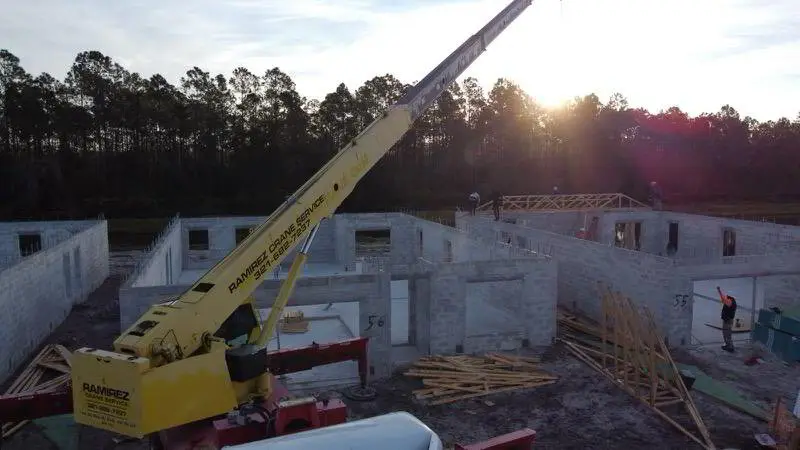
Mobile crane lifting a tilt-up concrete wall panel at a warehouse site in Spartanburg, South Carolina
Spartanburg, SC

Crane Operator Certification in Spartanburg, South Carolina

Warehouse panels, plant equipment and highway work all need certified crews. Here is how Spartanburg employers and operators can prepare.

Distribution Centers and Industrial Growth

Spartanburg sits where I-85 and I-26 cross, close to the inland port in Greer, and that location has drawn a long run of distribution centers and manufacturing plants. Large warehouses are frequently built with tilt-up concrete panels, which means big crane lifts, careful rigging and a lot of coordination with the ground crew.

For contractors and operators seeking crane certification in Spartanburg, SC, those panel jobs and plant installs are where certified skills get tested every day. Plant expansions along the same corridor add equipment sets, steel erection and maintenance picks to the mix.

The Crane School is a training provider based in Seffner, Florida, with no Spartanburg location. We prepare candidates for NCCCO exams through on-site training at your facility or open classes at our campus.

What Tilt-Up and Plant Lifts Demand

A tilt-up panel lift involves rotating a heavy slab from flat to vertical, with load and rigging forces changing throughout. The operator, rigger and signal person must work as one unit, often with a blind phase during the lift.

For crews doing this work, we usually recommend:

Our article on the arts of rigging and signaling goes deeper on that teamwork.

Getting Practice Time Before the Practical

Experienced operators sometimes struggle on the NCCCO practical because the test rewards precise control over a set course. Candidates who travel to Seffner can reserve hourly practice time on telescopic or lattice cranes before testing, with or without coaching. The mobile crane prep weekend also offers optional practice slots the Thursday before practical exams.

For on-site groups in Spartanburg, practice is built into the training days on your own equipment. That matters for tilt-up crews, because practicing on the actual crane they will run builds familiarity with its controls, load moment indicator and setup.

Candidates who need a written-only retest can sit for it at our Seffner headquarters, where CCO written exams are offered every month.

Weather and Seasons in the Upstate

Expect hot, humid summers, strong afternoon storms and the occasional winter ice event. Wind is a particular concern for panel lifts because large flat surfaces catch gusts. Make sure operators know the wind limits in their crane's manual and how to measure wind on-site. A panel that rotates easily on a calm morning can become unmanageable when afternoon storms roll in, so plan the heaviest picks early in the day.

Rules and How to Book

South Carolina relies on OSHA's federal crane standards rather than a separate state operator license, and employers may add their own requirements. Our South Carolina training overview has more. We have no Spartanburg office; we come to your site or you come to ours. Call or use the contact form to start planning.

Have your crew size, crane types and preferred dates ready when you call; it speeds up planning considerably.

Frequently Asked Questions

Can we schedule training around a warehouse project start?

Yes. Give us your project timeline and number of candidates, and we will look for on-site dates that get your crew certified before the heavy lifting begins.

Is practice time available before testing in Seffner?

Yes. TSS and TLL practice and lattice practice can be booked by the hour, with or without coaching.

Does every person on a tilt-up crew need to be certified?

OSHA requires certified crane operators and qualified signal persons and riggers for most construction lifts. Certification for signal persons and riggers is often an employer or contract requirement.

The Crane School

Training Programs & Services

All programs are delivered in compliance with current OSHA regulations.

Mobile Crane Operator Certification Prep Program

For experienced operators ready to certify or recertify. Includes NCCCO TSS, TLL and LAT written and practical exams.

Learn more about Mobile Crane Certification Prep

Initial Mobile Crane Operator Training Program

For people with little or no crane experience. 3-week (TSS/TLL) and 5-week (adds LAT) programs with NCCCO exams.

Learn more about Initial Mobile Crane Training (3 & 5 Week)

Articulating Crane Operator Certification Prep Program

For knuckle-boom operators. Prepares you for the NCCCO ABC, ABL and ABW written and practical exams.

Learn more about Articulating Crane Certification Prep

Rigger Qualification / Certification Program

For personnel who rig loads to cranes — supports your rigger qualification and NCCCO Rigger Level I/II exams.

Learn more about Rigger Level 1 & 2

Signalperson Qualification / Certification Program

Standard hand and voice signals for directing cranes, plus preparation for the NCCCO Signalperson exams.

Learn more about Signalperson

Managing Crane Safety Class

For managers and supervisors: OSHA compliance, lift planning, inspections, certification and liability.

Learn more about Managing Crane Safety

Telehandler Operator Program

Certification or recertification for telehandler operators. Includes the NCCCO THO written and practical exams.

Learn more about Telehandler Operator

Crane Inspection Services

Annual, monthly, post-assembly and post-incident inspections plus load testing by NCCCO-certified inspectors.

Learn more about Crane Inspections

Related Reading

Course

TSS and TLL Practice Per Hour

Book hourly seat time on fixed cab (TSS) or swing cab (TLL) telescopic cranes before your NCCCO practical. $150 per hour. Request your practice time.

Crane Operator Practice Test

Ten quick questions on crane safety rules and NCCCO basics. Pick one answer per question — your score shows on the next page.

1. Which OSHA standard covers cranes and derricks used in construction?
2. How long is an NCCCO crane operator certification valid before recertification?
3. What does NCCCO stand for?
4. Under OSHA's current construction crane rule, operator certification must be obtained by:
5. Under OSHA Table A (1926.1408), what is the minimum clearance from power lines rated up to 50 kV?
6. When is a signal person required?
7. Whose emergency stop signal must a crane operator obey?
8. What does an anti-two-block device prevent?
9. Which document gives a crane's rated capacity for a given boom length and radius?
10. Which NCCCO designation covers telescopic boom cranes with a swing cab?