
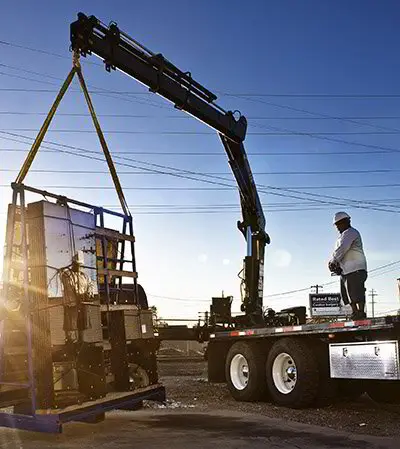
Articulating boom truck lifting equipment at a grain facility near Brookings, South Dakota
Brookings, SD

NCCCO Crane Training for Brookings, South Dakota

A university town surrounded by farm country needs crane skills for campus building, ag processing and wind energy. Here is how to train for them.

Campus Construction Meets Farm Country

Brookings is home to South Dakota State University, which brings regular campus construction and research facility work. The surrounding counties are deeply agricultural, with grain storage, feed and processing facilities, and ethanol plants in the wider region. Wind energy development across eastern South Dakota adds another type of heavy lifting.

For NCCCO crane training in Brookings, SD, that means preparing people for a range of machines, from articulating cranes on service trucks to large mobile cranes on industrial projects.

Ag, Ethanol and Processing Sites

Agricultural and ethanol facilities rely on lifting for tank work, conveyor and leg installations, and equipment change-outs. Much of that is done with boom trucks and articulating cranes, plus telehandlers for everyday material handling.

  • Articulating crane certification prep prepares operators for NCCCO ABC, ABL and ABW exams.
  • The telehandler program covers the NCCCO THO exam for both first-time certification and renewals.
  • Rigger training helps maintenance crews rig heavy components correctly.

Plants with in-house maintenance teams often find that training their own people reduces reliance on outside crews for routine lifts. Our guide to telehandler certification explains how the THO exam works.

For Students and Career-Changers

If you are a student or recent graduate in Brookings looking at a hands-on trade, crane operation is one option. People with no experience start with the initial mobile crane operator program at our Seffner, Florida campus, either three weeks for telescopic cranes or five weeks with lattice boom. Classes run Monday through Thursday, 7:00 AM to 4:00 PM.

For realistic pay figures, look at the BLS Occupational Employment and Wage Statistics for crane and tower operators. Then talk with local employers about what credentials they want.

Be realistic about the commitment: the initial programs are full-time and away from home, and you will be responsible for your own travel and lodging. We have a negotiated rate at a Holiday Inn Express near our campus, which many out-of-state students use.

Prairie Weather and Planning

Eastern South Dakota is windy, and winter cold and blizzards can shut down outdoor work for days. Spring planting and fall harvest are also the busiest times at ag facilities, so many employers prefer to schedule training in summer or in the quieter weeks of late winter for classroom work.

Wind turbine work deserves its own mention. Erecting and servicing turbines involves large crawler and mobile cranes, long booms and strict wind limits. Operators on those crews typically need the NCCCO LAT designation for lattice boom cranes in addition to telescopic credentials, along with strong rigging and signaling support on the ground.

Rules, Location and Next Steps

Federal OSHA crane rules govern construction lifting in South Dakota, which is not among the states commonly cited for a separate crane license. Employers may add their own requirements. The Crane School has no office in Brookings; we train on-site or at our Florida campus. See the South Dakota crane school page for statewide notes, and contact us to plan.

If you run a small ag business with a single operator, open enrollment in Seffner may be simpler than hosting an on-site visit.
Frequently Asked Questions

Can you train at an ethanol plant or grain facility?

Yes, if the facility can provide suitable equipment and a safe area for practice and practical exams. Site safety rules and access are set by the facility.

What certification covers a knuckle boom on a service truck?

Articulating cranes are covered by the NCCCO ABC, ABL and ABW designations, depending on configuration.

Can a college student enroll in the initial crane program?

Yes, if you can commit to the schedule. The programs are full-time for three or five weeks at our Florida campus, so call us to talk through timing and NCCCO's candidate requirements.

The Crane School

Training Programs & Services

All programs are delivered in compliance with current OSHA regulations.

Mobile Crane Operator Certification Prep Program

For experienced operators ready to certify or recertify. Includes NCCCO TSS, TLL and LAT written and practical exams.

Learn more about Mobile Crane Certification Prep

Initial Mobile Crane Operator Training Program

For people with little or no crane experience. 3-week (TSS/TLL) and 5-week (adds LAT) programs with NCCCO exams.

Learn more about Initial Mobile Crane Training (3 & 5 Week)

Articulating Crane Operator Certification Prep Program

For knuckle-boom operators. Prepares you for the NCCCO ABC, ABL and ABW written and practical exams.

Learn more about Articulating Crane Certification Prep

Rigger Qualification / Certification Program

For personnel who rig loads to cranes — supports your rigger qualification and NCCCO Rigger Level I/II exams.

Learn more about Rigger Level 1 & 2

Signalperson Qualification / Certification Program

Standard hand and voice signals for directing cranes, plus preparation for the NCCCO Signalperson exams.

Learn more about Signalperson

Managing Crane Safety Class

For managers and supervisors: OSHA compliance, lift planning, inspections, certification and liability.

Learn more about Managing Crane Safety

Telehandler Operator Program

Certification or recertification for telehandler operators. Includes the NCCCO THO written and practical exams.

Learn more about Telehandler Operator

Crane Inspection Services

Annual, monthly, post-assembly and post-incident inspections plus load testing by NCCCO-certified inspectors.

Learn more about Crane Inspections

Related Reading

Training Program

Telehandler Operator Certification Program

Telehandler certification prep for the NCCCO THO written and practical exams, fixed or rotating. Certify or recertify. Join the list for upcoming dates.

Crane Operator Practice Test

Ten quick questions on crane safety rules and NCCCO basics. Pick one answer per question — your score shows on the next page.

1. Which OSHA standard covers cranes and derricks used in construction?
2. How long is an NCCCO crane operator certification valid before recertification?
3. What does NCCCO stand for?
4. Under OSHA's current construction crane rule, operator certification must be obtained by:
5. Under OSHA Table A (1926.1408), what is the minimum clearance from power lines rated up to 50 kV?
6. When is a signal person required?
7. Whose emergency stop signal must a crane operator obey?
8. What does an anti-two-block device prevent?
9. Which document gives a crane's rated capacity for a given boom length and radius?
10. Which NCCCO designation covers telescopic boom cranes with a swing cab?