The Federal Baseline for South Dakota Operators
If you are pursuing South Dakota crane operator certification, you will work under federal rules rather than a state license. South Dakota is not on the list of states commonly cited for a separate crane license, so OSHA's 29 CFR 1926 Subpart CC sets the requirement on construction work. Section 1926.1427 says operators must be certified by an accredited testing organization or qualified through an approved employer program.
NCCCO certification is the route most contractors and suppliers recognize. NCCCO certifies by equipment type, and you must pass a written and a practical exam for each type. The Crane School prepares you for those exams; NCCCO issues the card.
Federal rules also require employer evaluation on the exact equipment you will run, and they cover equipment many people do not think of as cranes, including many boom trucks and knuckle boom units used for material delivery. Employers can always set stricter requirements than OSHA, so ask what a company expects before you apply.
Knuckle Booms, Boom Trucks and Small Crews
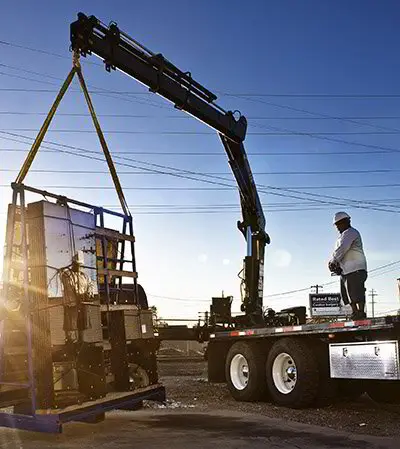
A lot of South Dakota crane work is done by small operations. A lumber yard delivering trusses, a precast supplier setting tanks or a farm contractor placing bins may have one or two operators running truck-mounted cranes. For these crews, the right certification depends on the machine.
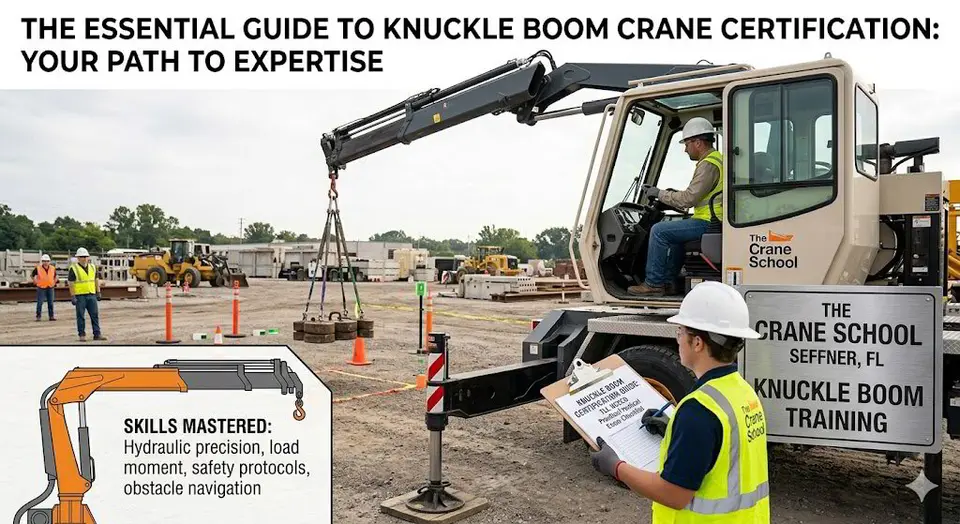
Articulating, or knuckle boom, cranes are certified separately from telescopic mobile cranes. NCCCO offers articulating crane designations for different configurations, and our articulating crane operator certification prep program prepares candidates for the ABC, ABL and ABW exams. If your boom truck is telescopic, the mobile crane designations may apply instead.
Not sure which applies? Look at the equipment and its manufacturer's information, then ask your employer or contact us. Our article on knuckle boom crane certification explains the differences in more detail.
Where South Dakota Puts Cranes to Work
Agriculture drives much of South Dakota's economy, and the industries around it need cranes. Grain storage, ethanol and processing plants, and equipment dealers all depend on lifting for construction and maintenance.
Sioux Falls has grown steadily, bringing commercial, medical and residential construction to the state's largest city. Rapid City and the Black Hills region see construction tied to tourism, public works and local growth, often on steep or rocky terrain. Wind energy projects and highway and bridge work add demand across the state. Along the Missouri River, which runs through the middle of the state, dams, bridges and public facilities create periodic maintenance and construction work that may call for larger cranes and experienced rigging crews.
Season and terrain
South Dakota sees cold, windy winters and hot summers. Wind on the open prairie is a factor nearly year-round, and frozen or saturated ground changes how a crane must be set up. In the Black Hills, grades and limited access require careful planning before a crane ever arrives on site.
Training On Site or at Our Seffner Facility
Because so many South Dakota employers run small crews spread across long distances, flexibility matters.
On-site training: our instructors can bring classroom prep and CCO practical exams to your yard or job anywhere in the state. Staff members who are NCCCO Accredited Practical Examiners can test operators on your own boom trucks or cranes, which is often easier than shipping people across the country.
Open enrollment in Florida: individuals can travel to our Seffner facility east of Tampa. CCO written exams are offered there every month, and practice hours on our equipment are available. A winter trip can be a welcome break from prairie weather.
Check the class schedule for open-enrollment dates, or ask about an on-site session.
Choosing a Program That Fits Your Equipment
- If you run a telescopic crane and have experience, the mobile crane certification prep program meets Friday to Monday each month and covers TSS, TLL and LAT exams.
- If you run a knuckle boom on a delivery truck, the articulating crane prep program is the closer fit.
- If you have never operated a crane, the initial mobile crane operator training program gives you three or five weeks of training before testing.
- If you handle loads with a telehandler on job sites or farms, consider the telehandler operator program for NCCCO THO exams.
Signalperson and rigger training are also worth considering, especially for crews that set loads in tight yards or near power lines.
If you are unsure, describe your equipment and the work you do when you call. We can suggest which exams fit before you commit to a class.
Building a Long-Term Crane Career in South Dakota
Many South Dakota operators start with a boom truck and gradually add certifications as they take on larger cranes or more complex lifts. A broad set of credentials can help you move between agriculture, construction and energy work.
Your NCCCO certification is valid for five years. For wage information, see the U.S. Bureau of Labor Statistics crane and tower operator data (opens in a new tab), which includes state-level figures.
Habits that carry a career
Operators who last in this trade tend to share a few habits. They inspect their equipment every shift and write down what they find. They read the load chart for every pick instead of trusting memory. They refuse a lift when the ground, wind or rigging is not right, and they explain why. Employers across South Dakota, from building suppliers to wind contractors, notice those habits more than any single credential.
Keep your hours and equipment types recorded in a logbook as well. When it is time to recertify, or when a new employer asks about your background, that record does the talking for you. It also helps you spot which crane types you should add next.