What Wisconsin Operators Need to Know About Certification
Wisconsin does not run its own private-sector OSHA plan, so federal OSHA enforces crane rules directly. On construction sites, that means Subpart CC, and 1926.1427 is the rule that requires every operator of covered equipment to be certified by an accredited organization or qualified through an approved program.
Nor does Wisconsin hand out crane operator licenses of its own, as far as the usual state-by-state lists go. In practice, Wisconsin crane operator training ends with an NCCCO card listing every crane type you passed, and then your company has to watch you run its particular machine and sign off before you work alone. Employers, project owners and some municipalities can require more, so ask before you start a new job.
Plenty of lifting in Wisconsin happens in shipyards, mills and factories, where general industry or maritime rules may apply instead of the construction standard. Even there, employers frequently use NCCCO certification as their yardstick, because it is portable, verifiable and backed by both a written and a hands-on test.
Mills, Shipyards and Lake Michigan Ports
Wisconsin's industrial roots run deep, and so does its demand for lifting.
Paper and pulp mills in the Fox Valley and along the Wisconsin River rely on overhead and mobile cranes for rolls, machinery and maintenance outages. Manufacturing around Milwaukee and across the state, from heavy equipment to engines and machinery, means frequent equipment installations and plant rearrangements.
Shipbuilding on Lake Michigan and Green Bay, at yards in places like Sturgeon Bay and Marinette, involves heavy module lifts and close coordination between crane crews and shipfitters. Ports in Milwaukee, Green Bay and Superior handle bulk and project cargo, and the docks need cranes for loading and maintenance.
Dairy and food processing, along with commercial, university and hospital construction in Madison and Milwaukee, round out the picture.
Winter Is Part of the Plan
Wisconsin winters are long and cold, and lake-effect snow can pile up near Lake Michigan and Lake Superior. Cold affects hydraulic systems, wire rope and the people running them, and frozen ground can hide soft spots that thaw later in the day.
Operators should know how cold weather affects their crane according to the manufacturer's instructions, how to clear snow and ice from walkways and steps, and how to recheck ground conditions as temperatures rise. Wind off the lakes adds another factor near the shore.
Winter is also when many Wisconsin construction crews have more time. That makes it a natural season for training, recertification and exam preparation. A few days in Florida in January or February is a schedule many northern operators appreciate.
Two Routes to Your Card
On-site in Wisconsin
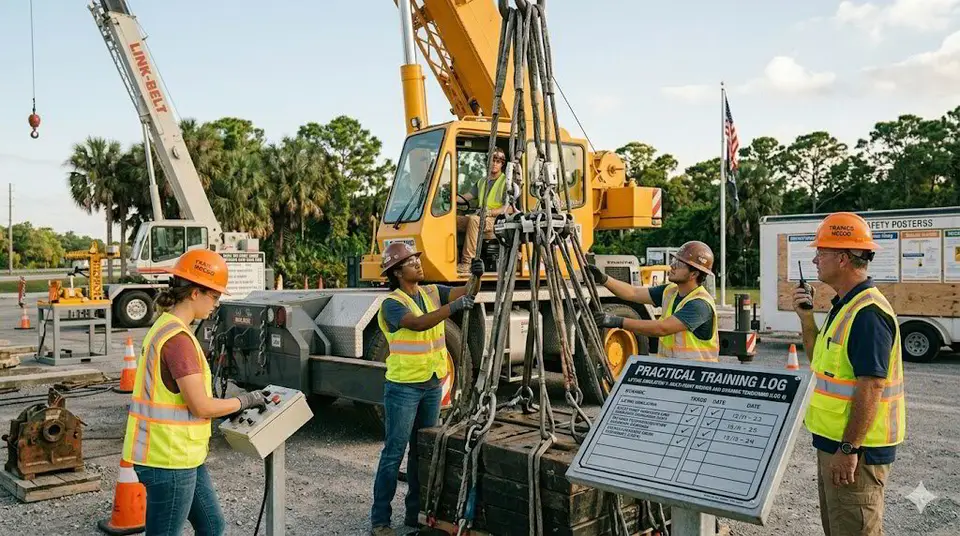
Mills, shipyards and manufacturers usually have several operators and riggers to train, plus strict plant safety rules. We can bring the classroom to your facility anywhere in the state, and because several of our staff are Accredited Practical Examiners, your people can test on the very crane they use on shift. Downtime stays low and the training matches your equipment.
Open enrollment in Seffner, Florida
Individual operators can travel to our training facility east of Tampa for open classes. Written NCCCO exams take place there every month, and hourly practice on our cranes is available before your practical. A nearby hotel gives our students a negotiated rate.
Upcoming dates are on our class schedule. For on-site training, send us a request with your location and crew size.
Which Program Fits a Wisconsin Crew
A mill maintenance tech who has run the yard hydro for a decade and a forklift driver who has never touched crane controls need very different things.
The seasoned hand mostly needs exam technique and a refresher on charts and rules. Our long-weekend mobile crane review puts the TSS, TLL and LAT practicals on Friday, two days of classroom over the weekend and the written tests Monday morning.
The newcomer needs seat hours first. The beginner mobile crane course gives three weeks on telescopic machines, or five with lattice boom added, before anyone sits for a test.
Shipyard and paper-mill riggers deal with odd centers of gravity, long rolls and modules every week. Our rigging course can feed your in-house qualified-rigger process or carry people through the NCCCO Level I and II rigger tests, and pairing it with signalperson training gets the whole ground crew on the same page.
Overhead cranes in the plant
Many Wisconsin mills and factories run bridge and gantry cranes indoors. Those cranes fall under general industry rules rather than Subpart CC, and our operator programs center on mobile, articulating and telehandler equipment. If indoor overhead cranes are your main need, say so up front so we can talk through what fits instead of signing you up for the wrong course. Our NCCCO certified inspectors do inspect overhead cranes, which many plants schedule alongside training.
From First Card to Long Career
If you are starting out, our step-by-step guide to becoming a certified crane operator explains the process from training through testing. Once certified, many Wisconsin operators add more crane types, rigging credentials or inspection experience over time.
Every five years, the card has to be renewed. Pay varies a lot between Milwaukee, Madison and the north woods, and the federal BLS survey of crane operator wages (opens in a new tab) is the most reliable way to compare.
Wisconsin's skilled trades have long passed knowledge from one generation to the next, and crane work is no exception. If you are new, find an experienced operator willing to let you oil, rig and watch. The habits you pick up in those first seasons, such as walking the site before setup and checking the chart every pick, last a whole career.