The Guide to Getting Mobile Crane Certification in Florida: Exams, Scheduling and Recertification
What Mobile Crane Certification Means
Mobile crane certification is proof, from an accredited testing organization, that you have the knowledge and skill to run a specific type of mobile crane safely. In Florida, as elsewhere, OSHA's construction rules require it for crane operators. NCCCO, the National Commission for the Certification of Crane Operators, is the most widely recognized certifier.
This article focuses on the exams: what they cover and how the process works when you pursue mobile crane certification in Florida. For the regulatory side, see our guide to mobile crane operator license requirements in Florida.
Before You Test: Candidate Basics
NCCCO publishes its candidate requirements on nccco.org (opens in a new tab). They include being at least 18, meeting its medical requirements, following its code of ethics and passing the written and practical exams within the required time window.
There is a common myth that NCCCO requires a fixed number of operating hours before you can test. Check NCCCO's current materials rather than relying on secondhand claims. What is certain is that you need enough real seat time to pass a practical exam and work safely, which is why training matters.
The Written Exams
Core exam
Every mobile crane candidate takes a core exam covering general knowledge that applies across mobile cranes. Expect topics such as:
- Site setup and ground conditions
- Operations, including signals and communication
- Technical knowledge such as load dynamics and wire rope
- Load charts and capacity
- OSHA rules, including power line safety
Specialty exams
You then take a specialty exam for each crane type you want: TSS (telescopic boom, fixed cab), TLL (telescopic boom, swing cab) or LAT (lattice boom crawler and truck). Specialty exams focus heavily on reading that crane type's load charts and calculating capacity.
How to prepare
- Practice load chart problems until you can work them quickly and accurately.
- Know how deductions for hook blocks, jibs and rigging affect net capacity.
- Read questions carefully; many errors come from rushing.
The Practical Exam
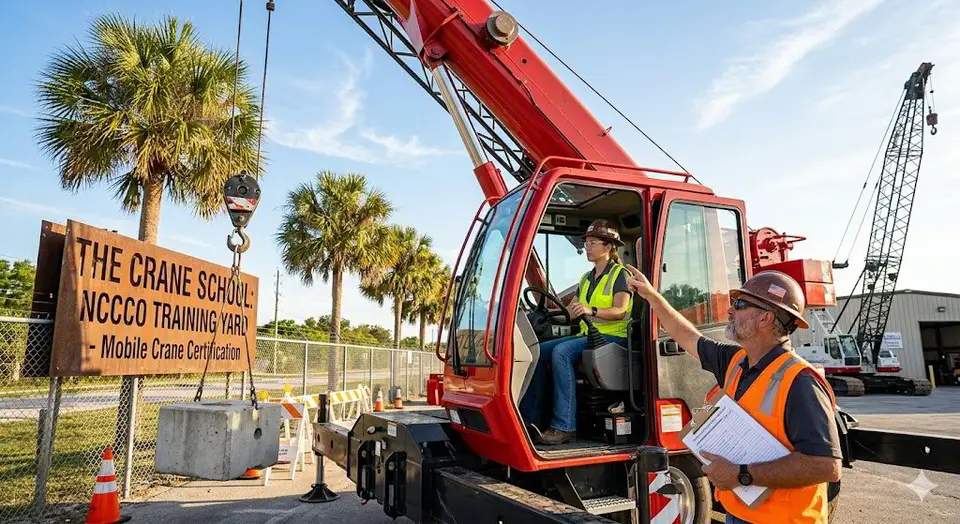
The practical exam is a hands-on test on the crane type, run by an accredited practical examiner. Candidates complete a set course of tasks that demonstrate control, precision and safe operation, and are scored on things like smoothness, accuracy and following safety procedures.
To prepare:
- Get as much seat time as possible on the same crane type you will test on.
- Practice slow, controlled movements; jerky operation costs points and creates hazards.
- Learn the standard hand signals well.
- Use any available practice time just before the exam to settle into the machine.
The Crane School offers TSS and TLL practice time by the hour, with or without coaching, for candidates who want extra seat time.
Testing Logistics in Florida
Here is how the process can work through The Crane School's Seffner headquarters, near Tampa:
- Written exams are offered every month at the Seffner facility.
- Practical exams can be scheduled with the school's accredited practical examiners, including on-site for employers.
- The monthly prep program for experienced operators runs Friday through Monday: practical exams Friday, classroom Saturday and Sunday, and written exams Monday morning. Reserved one-hour practice slots are available the Thursday before.
Beginners usually test at the end of the 3-week or 5-week initial training program. Ask our staff for upcoming dates.
Common Reasons Candidates Fall Short
Instructors see the same issues come up again and again:
- Load chart shortcuts. Candidates who memorize a few chart patterns struggle when a question uses a different configuration. Learn the method, not just the answers.
- Forgetting deductions. Leaving out the hook block, jib or rigging weight is one of the most common written-exam errors.
- Not enough seat time. Classroom knowledge does not translate into smooth control without hours on the machine.
- Rushing the practical. Speed is not the goal. Controlled, deliberate movement wins.
- Nerves and fatigue. Sleep well, eat, and arrive early so you are not flustered before you start.
Knowing these pitfalls in advance lets you build your study plan around them.
After the Exams: Results and Your Card
NCCCO reports results and they can be viewed in its MyCCO app. Once you have passed all required written and practical exams and met the other requirements, your card typically arrives within a few weeks. If you have questions about results, NCCCO's testing services team is the right contact.
If you fail a portion, you can retest. Find out what you missed, put in more practice and reschedule. Ask about The Crane School's published written-exam guarantee when you enroll.
Keeping Your Certification Current
CCO certifications are valid for five years. To recertify, you retake the required written specialty exams before expiration and meet NCCCO's other recertification conditions. Plan to recertify during the final year so you have time to retest if needed.
The mobile crane operator certification prep program is set up for recertifying operators as well as experienced operators testing for the first time. Mark your expiration date and schedule early.
Start Your Certification Plan
Choose your designations, get real seat time, practice load charts and book your exams. For an overview of all Florida training options, see the Florida NCCCO training page. If you are not sure which designations or which program fit your experience, contact The Crane School and talk it through with staff who work with NCCCO candidates every month. A short conversation now can save you from testing on the wrong crane type or booking the wrong course.
FAQ
Do I have to take the core exam for each crane type?
No. You take the core exam once along with a specialty exam for each crane type you want. Check NCCCO's current rules for timing requirements.
Can I take the practical exam before the written exam?
In the monthly prep program, practical exams are on Friday and written exams on Monday. Check NCCCO's rules for the required time window between passing both.
How long until my NCCCO card arrives?
Cards typically arrive a few weeks after you pass all requirements. You can check results in NCCCO's MyCCO app.
Do I retake the practical exam to recertify?
Recertification centers on the written specialty exams, along with NCCCO's other conditions such as operating experience. Confirm current requirements with NCCCO before your card expires.