What to Expect in Mobile Crane Certification Prep
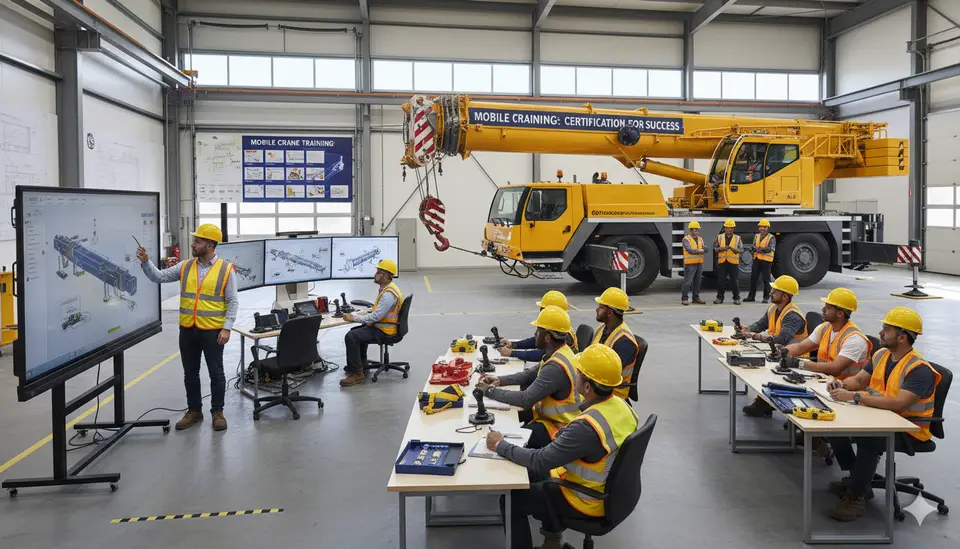
Who Mobile Crane Certification Prep Is For
Mobile crane certification prep is not beginner training. The Crane School's certification prep program is designed for two groups:
- Operators with real seat time who have not yet earned NCCCO certification
- CCO-certified operators who are recertifying
If you have little or no operating experience, this format is not a good fit. The initial mobile crane operator training program builds skills from the ground up over three or five weeks. Our post on what to expect in crane operator training walks through that longer experience.
The prep program covers NCCCO TSS (telescopic boom, fixed cab), TLL (telescopic boom, swing cab) and LAT (lattice boom crawler and truck) written and practical exams, depending on what you need.
The Four-Day Schedule
The program runs once a month, Friday through Monday:
| Day | What happens |
|---|---|
| Thursday (optional) | Reserved one-hour practice slots |
| Friday | Practical exams |
| Saturday–Sunday | Classroom review |
| Monday morning | Written exams |
The order surprises some people: practical exams come first. That is part of why the program suits experienced operators. You are expected to arrive ready to demonstrate control, not to learn it over the weekend.
Thursday: Optional Practice
If you have not been in a particular type of crane recently, or you want to get a feel for the training equipment, book practice time the Thursday before. Slots are reserved in one-hour blocks.
Use the time with a purpose:
- Get comfortable with the controls and sight lines of the machine you will test on
- Run through the kinds of tasks found on a practical course: controlled hoisting, swinging to targets and accurate placement
- Work on your weakest skill, not your strongest
Hourly practice can also be booked separately; see TSS and TLL practice per hour or lattice practice in the store.
Friday: Practical Exams
Practical exams are performed on a crane in front of an NCCCO accredited practical examiner. You will complete set tasks on a test course within time limits, and the examiner evaluates control, accuracy and safe operation.
What helps on exam day:
- Do a full pre-operation inspection as you would on any job.
- Move smoothly. Jerky inputs and a swinging load cost more than taking your time.
- Listen carefully to the examiner's instructions before you begin.
- Reset if needed. If something feels wrong, stop and correct it rather than forcing it.
- Stay hydrated. Florida heat is real, even for experienced operators.
Saturday and Sunday: Classroom Review
The weekend focuses on the knowledge tested on Monday's written exams. Expect review of:
- OSHA crane rules for construction (29 CFR 1926 Subpart CC), including recent changes since you last certified
- Load charts for the crane types you are testing on, with plenty of practice problems and deductions
- Setup and stability, including outriggers, ground conditions and configuration
- Operations, including signals, power line clearances and wind
- Inspection requirements
Experienced operators sometimes underestimate the written exams. Running a crane every day is not the same as answering chart questions under time pressure. Take the weekend seriously.
Monday Morning: Written Exams
Written exams take place Monday morning. Read every question fully, write out your chart calculations step by step and double-check your deductions.
The Crane School publishes a written-exam guarantee: if you do not pass your NCCCO crane operator written exams, the class is free until you do. Ask for the details when you enroll.
After you pass, cards typically arrive a few weeks later. For questions about exam results, NCCCO Testing Services can help.
Where Experienced Operators Slip Up
Years in the seat are a big advantage, but they bring habits that can cost points:
- Skipping steps you do on autopilot. Examiners can only credit what they see, so make your inspection and checks visible.
- Rushing. Working fast on a job site is often rewarded; on a timed practical course, smooth control matters more than shaving seconds.
- Relying on the LMI instead of the chart. The written exams expect you to work capacities by hand, including deductions.
- Assuming the rules have not changed. If you last certified five years ago, review what is new before Monday.
Recertifying? A Few Notes
CCO certifications are valid for five years, and recertification adds another five. Plan to start in the final year before expiration so you have time to reschedule if needed.
For recertification candidates, options include the recertification prep class (classroom only) and practical-exam-only products. Check NCCCO's current recertification requirements to confirm which exams you need, since requirements can depend on your hours and situation.
Combining a renewal with a new designation, such as adding LAT to an existing TSS/TLL card, can save a second trip.
How to Prepare Before You Arrive
- Review your crane types. Know exactly which designations you are testing for.
- Work load chart problems for a week or two beforehand.
- Read through the OSHA crane rules overview, especially if you are recertifying after five years.
- Book lodging early. The Crane School has arranged a special rate at the Holiday Inn Express Tampa Fairgrounds; see the hotels page.
- Pack properly. Hard-toe footwear, hard hat, work clothes, gloves, sunglasses, a government-issued photo ID and a valid driver's license.
- Reserve Thursday practice if you are rusty on any crane type.
Reserve Your Seat
Prep weekends run monthly and fill up. Check open dates on the class schedule, or contact us to confirm which exams you need.
FAQ
Why are practical exams before the classroom review?
The program is built for experienced operators who arrive ready to demonstrate control. The weekend review then focuses on knowledge for Monday's written exams.
Can a beginner take the certification prep program?
No. It is not designed for people without operating experience. Beginners should start with the 3-week or 5-week initial training program.
How often is the certification prep program held?
Once a month, Friday through Monday, with optional practice the Thursday before.
Can I take only the practical exam?
Practical-exam-only options are listed in the store for TSS or TLL and for LAT. Contact us to confirm what fits your situation.